
Is a Stable Door Practical in a Modern Home?
A stable door can be practical in a modern home when opening its top half provides a useful connection with the outside. That might suit a utility room beside a working garden or a kitchen overlooking a sheltered courtyard. Its traditional associations do not determine whether it belongs in the project.
The useful test is how often the split operation would help, and what compromises come with it. Handles, closing sequences, ventilation, exposure and maintenance all matter. Choose from those everyday considerations first, then judge the door’s appearance within the house, rather than expecting country styling or a contemporary finish to settle the practical questions.
How Does a Stable Door Actually Work?
A stable door divides the moving leaf horizontally so that its upper and lower parts can be operated separately. A joining mechanism allows them to function together as a full door. Endurance’s stable-door information illustrates this principle with an interlocking bolt. The details of handles, locks and controls depend on the selected product.
Ask for the complete operating sequence. Understand how the halves are connected, how each is secured and what must happen before opening or closing. A drawing can show the split but leave those questions unanswered. The manufacturer should explain the permitted states clearly, including which positions are intended for ventilation, access and secure closure when leaving the home.
Opening direction is another specification choice that needs confirmation. Do not assume every stable door can open either way or that all examples operate like one seen elsewhere. The available configuration must suit the frame, threshold and hardware as well as the space. Establish the actual movement of both halves and their relationship with surrounding walls and furniture.
Where possible, operate a relevant example yourself. Try it as a conventional door before separating the halves, then reconnect and close it using the specified controls. This reveals whether the mechanism feels straightforward for the household. Similar appearances can conceal different everyday routines, so the useful comparison concerns the complete operation rather than the horizontal division alone.
Where Is a Stable Door Most Useful in a Modern Layout?
A stable door earns its place when it supports a recurring activity. Someone working between a utility room and garden may value opening the upper half while keeping the lower portion closed. A kitchen beside a sheltered courtyard can offer another suitable setting. The important relationship is between the room, the outdoor space and the person using them.
Map the ordinary routes through the home. Consider muddy boots, laundry, garden tools, shopping and deliveries. Establish whether the door is a secondary connection or the principal way everyone enters and leaves. A feature that works well for occasional use may be less convenient when the whole household repeatedly passes through carrying things throughout the day.
Consider what happens outside the opening. A quiet garden-facing position differs from an entrance beside a public route, vehicle movement or an exposed service yard. Noise, dust and privacy can reduce the attraction of leaving the top open. A generous view from the kitchen does not establish that the same opening will be comfortable during normal household routines.
In Wiltshire or Somerset, the decision may arise during a rural-home renovation; in Bristol it may concern a compact courtyard. Neither setting automatically calls for a stable door. Begin with a specific use that benefits from split operation. If the household struggles to identify one, a conventional door may provide a simpler and equally convincing connection with the outside.
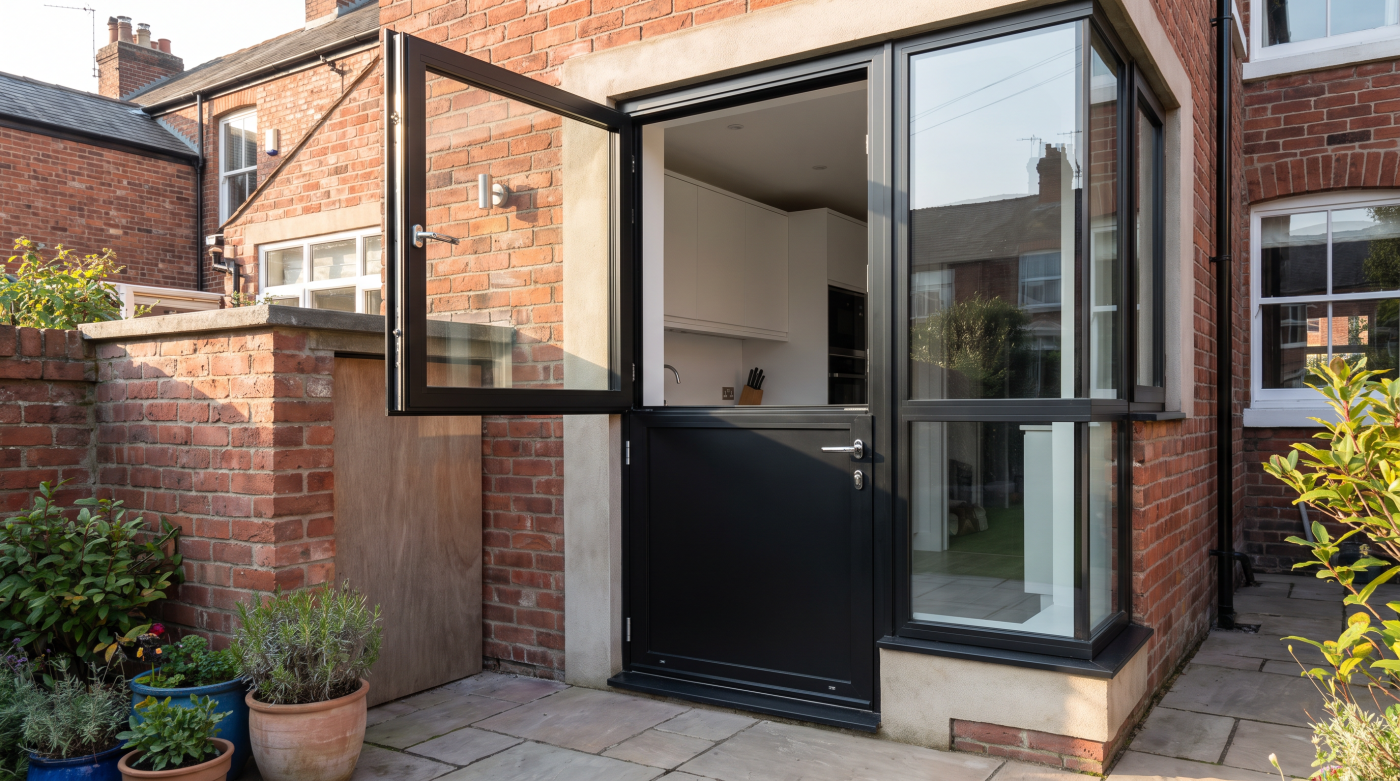
Is Opening the Top Half a Useful Ventilation Strategy?
Opening the upper half can provide welcome fresh air while someone is using the adjoining room. Its usefulness depends on weather, available airflow and the other openings in the home. It is an occupant-managed option: someone chooses when to open it, how long to leave it and when conditions make closing it more sensible for comfort or security.
That function should be distinguished from the home’s designed ventilation provision. England’s Approved Document F addresses ventilation requirements and associated guidance. An intermittently opened stable door should not be assumed to replace the required background, whole-dwelling or extract provision. Establish the appropriate strategy for the particular building and the scope of work being undertaken.
For a utility room, moisture from laundry may require attention even when nobody wants an external opening. A kitchen similarly needs a coordinated response to cooking pollutants and moisture. Split operation can complement daily use, but its appeal on a mild afternoon does not demonstrate that the room will be properly ventilated throughout winter or while the household is away.
Consider noise, insects, wind and temperature before treating the feature as an everyday solution. Check whether a suitable restraint or screen is available without interfering with normal operation. The best arrangement allows the household to enjoy fresh air when conditions suit while the building’s necessary ventilation continues to function independently of a decision to leave part of the door open.
What Should Families and Pet Owners Consider?
The idea of keeping the lower half closed while the upper half is open can appeal to families and pet owners. Treat that as a household-use question requiring care. A lower door section is not automatically a tested child-safety gate, suitable guarding or a reliable enclosure for every animal simply because it provides a visible obstacle.
Children’s reach, climbing and changing abilities matter, as do access to handles and the space around the door. A layout that seems manageable for a small child may behave differently as they grow. Consider supervision and the consequences of someone opening either half. Obtain appropriate safety advice where a barrier is needed rather than relying on the door’s description.
Pets introduce different questions. An animal may jump, climb, push against the door or react to activity beyond it. The height and arrangement of the lower half do not establish containment for a particular pet. The external setting matters too: an opening towards a secure garden differs from one overlooking a road or an unfenced shared approach.
Security against intrusion must also be assessed in the correct state. A door with its upper half open is not equivalent to the complete doorset closed and locked. Confirm the manufacturer’s instructions and consider whether anyone can reach controls from outside. Choose the arrangement for its useful operation, while meeting any child, pet and household security needs through appropriate measures.
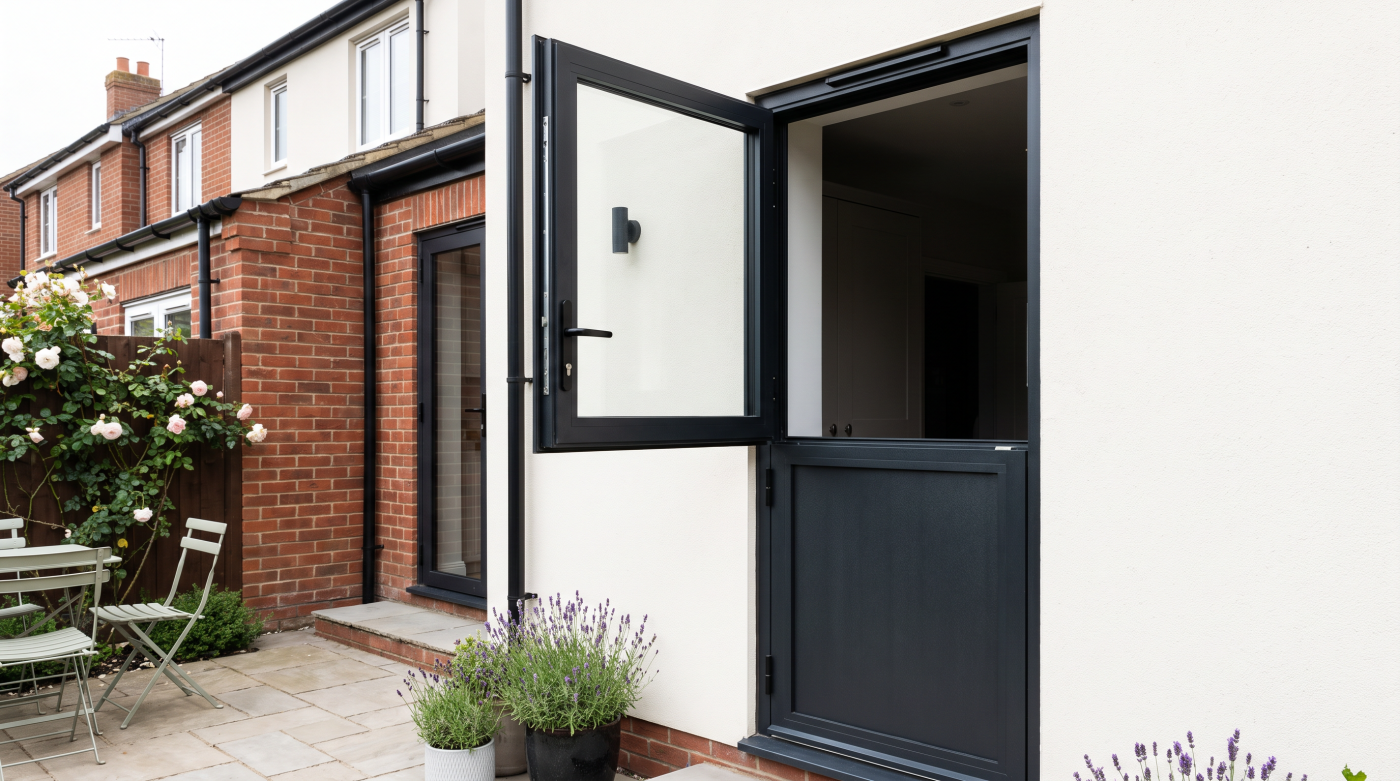
Are Stable Doors Comfortable and Convenient to Use Every Day?
The door should work comfortably as a full entrance, because that may be how it is used most often. Test the handles, key or thumbturn where specified, and the force needed to move the joined leaf. A favourable impression of the split feature can distract from an awkward everyday action repeated whenever someone carries shopping or laundry through.
Check how the halves are joined and whether the required action is within easy reach. Ask what order they must close in and how to confirm that both are properly secured. Include the household’s regular users in the assessment. Someone with limited grip, reach or balance may experience a control differently from the person demonstrating it in a showroom.
Draw the movement of each half near furniture, worktops and nearby openings. Separately moving sections can create contact or trapping points that deserve explanation. Ask about appropriate restraints and the manufacturer’s safe operating instructions. A convenient hold-open position should be a supported feature, with suitable fixing and clearance, rather than an improvised arrangement that loads the door incorrectly.
Discuss how visitors or other household members will understand the controls. The everyday sequence should be clear enough to use consistently without repeated adjustment or uncertainty. If operating the split adds complexity but provides little regular benefit, simplicity has value. The appropriate choice is the one that suits the actual users and routines, including the ordinary task of leaving home securely.
What Happens at the Joint Between the Two Halves?
The horizontal meeting joint is a defining part of a stable door. It must accommodate the relationship between two moving sections while contributing to the assembly’s intended performance. Ask how it seals, how the halves align and what maintenance is required. The presence of a joint does not prove poor performance, but it creates a detail worth understanding before selection.
Request evidence for the proposed stable-door configuration rather than accepting information for a conventional door in the same material. Dimensions, glazing, threshold and opening direction can affect which results apply. Any quoted thermal figure should have its scope explained, and weather or security statements should relate to the complete relevant assembly rather than one shared component.
Exposure belongs in that review. An entrance under a substantial porch differs from an unsheltered opening facing driving rain. Coordinate external levels, water management and surrounding junctions with the builder. A good doorset cannot by itself resolve water directed towards an inappropriate threshold or gaps left between the frame and adjacent construction during installation or later alterations.
Establish how alignment and seals will be checked over time. Ask which adjustments require a competent specialist and whether replacement components remain accessible. Maintenance instructions should cover both halves and their joining mechanism. Understanding those responsibilities helps the household compare a stable door with simpler alternatives on a realistic basis, including upkeep as well as the initial appearance and purchase cost.
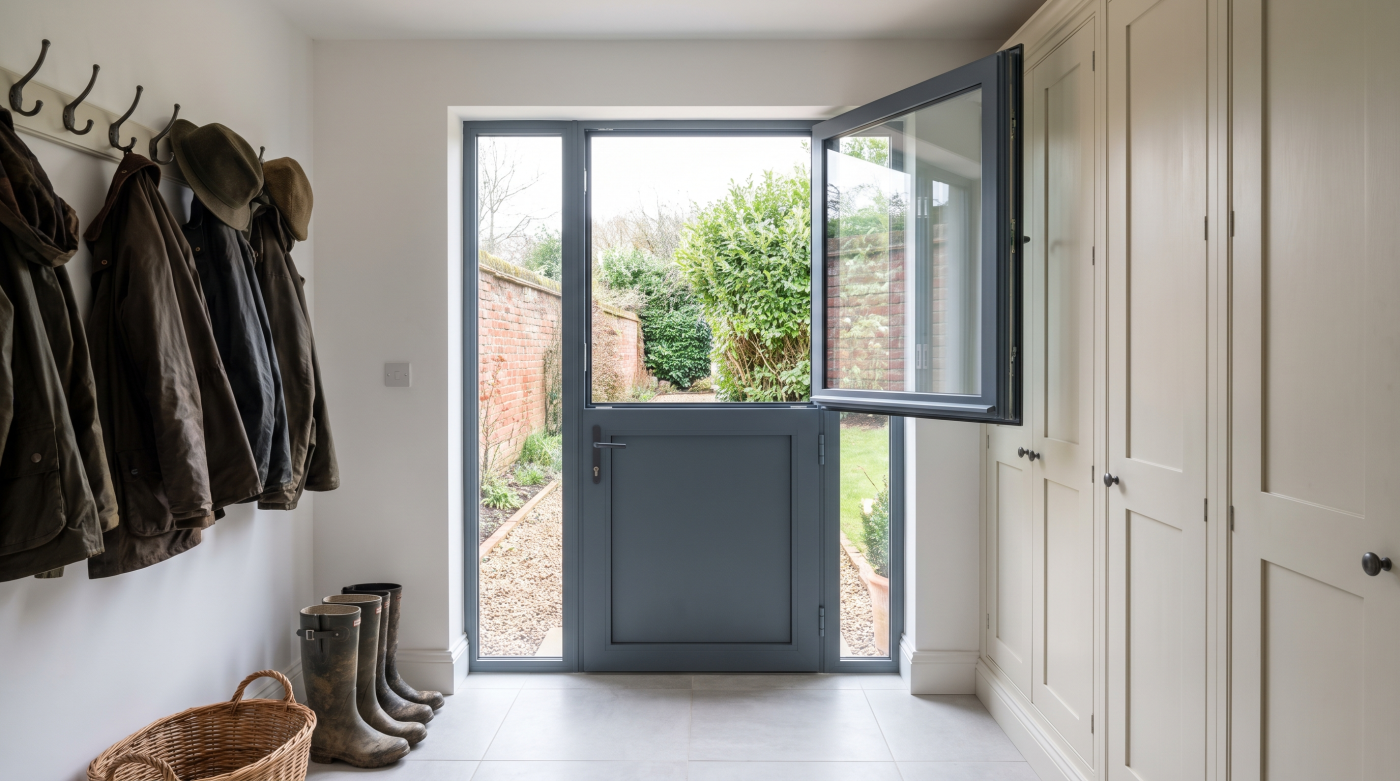
Can a Stable Door Look Right on a Contemporary Home?
A stable door does not have to reproduce a farmhouse appearance. Its visual character depends on panel layout, glazing, frame depth, colour and hardware as well as the split. A restrained design may sit comfortably within a modern extension. The horizontal division remains visible, however, and should be judged as part of the elevation rather than ignored during selection.
Consider the view from inside the room. The division may align with a worktop, interrupt an outlook or create a useful distinction between solid and glazed areas. Those effects depend on the actual dimensions. A generic image cannot establish the relationship with this kitchen or utility room, so request an elevation showing the relevant internal heights and adjacent fittings.
Assess the relationship with neighbouring windows and doors. A very different glazing pattern or heavy frame may appear disconnected even when the colour matches. Equally, a deliberate change can work when the architectural reasoning is clear. The design should explain why split operation and its associated divisions belong at this opening, beyond an attraction to the door type itself.
Where an existing historic door is involved, style selection comes after significance and the relevant controls have been considered. Historic England’s advice on altering doors supports assessing retention and repair. A rural appearance does not establish heritage suitability, and a new stable door should not be assumed an acceptable replacement solely because the building is a cottage.
When Would a Conventional Door Be the Better Choice?
A conventional door may be preferable when the upper half would rarely be opened or when straightforward access is the main priority. It removes the need to manage two sections and their joining mechanism. That does not make it the right answer for every home, but it creates a useful baseline against which the stable door’s additional function can be judged.
Compare the complete proposals. Include the frame, glass, hardware, threshold, installation, surrounding work and maintenance requirements. Consider whether a suitable opening window could provide the desired fresh air while a conventional door serves access. The alternative should be assessed properly, rather than assuming that the choice is between a stable door and a room without any useful ventilation option.
Record the intended use before selecting a product. Identify who will operate the split, where each half moves, how it is held and how the entrance is secured. Confirm any necessary approvals for the alteration separately. A brief based on real routines gives the architect, builder and glazing specialist a more reliable basis for discussing suitable options and limitations.
CBP’s approach as an architectural glazing and specification partner begins with that relationship between the home and its occupants. A stable door is practical when split operation delivers a regular benefit within a suitable, properly detailed entrance. Its appeal should survive a careful review of daily use, exposure and upkeep; if it does, the traditional concept can serve a thoroughly modern household.