
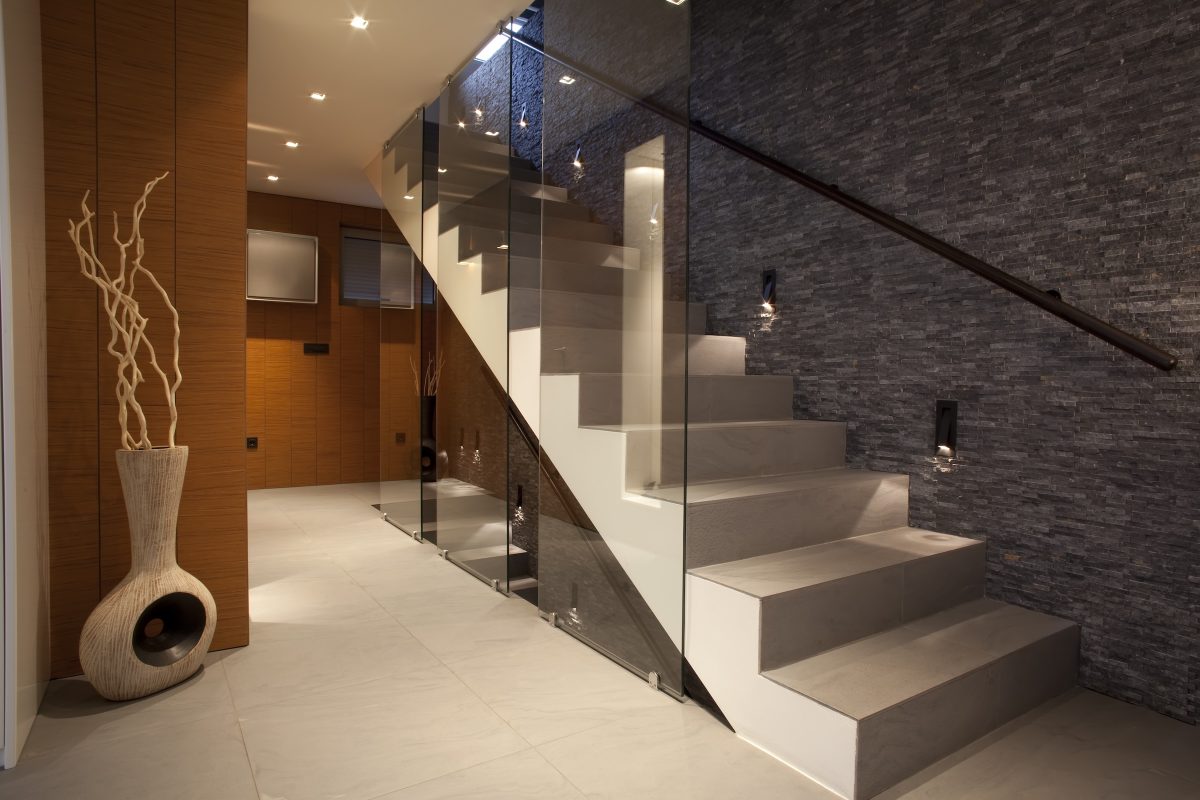
Glass balustrades come up in conversation more often than many homeowners expect. Usually, the discussion starts once the main windows and doors have been chosen and the project moves on to staircases, landings, raised terraces or a balcony shown on the plans. A balustrade can feel like a small part of the overall build, but it often has a significant effect on how the finished space looks and feels.
At CBP, we supply and install Q-Railing systems because the range gives us flexible, well-engineered components that can be specified properly for different projects. This article explains what glass balustrades and Juliet balconies involve, where they are commonly used and which decisions matter most before you choose a system.
A balustrade is a kit of parts, not one fixed product
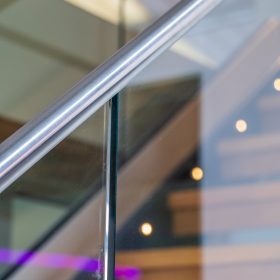
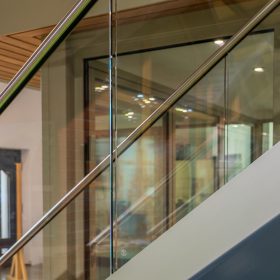
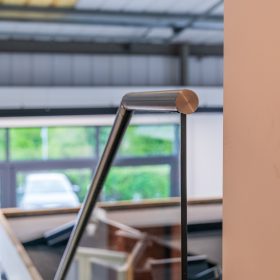
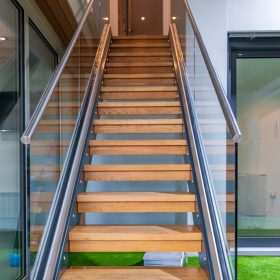
Q-Railing is not one single balustrade design. It is a modular system made up of glass panels, baluster railings, handrails, glass clamps, adapters and fixing components. These parts can be combined in different ways depending on the property, the structure and the finished appearance required. This matters for your project because balustrade designers need to have a glass balustrade solution for an open-plan staircase, a balustrade around a raised terrace and a simple wall-mounted handrail for a hallway. So while these may all come from the same product family, each will be specified and built differently. You are not just choosing between a few fixed designs. You are deciding how the components work together for your particular space.
At one end of the range are glass railings, designed to keep views as open as possible. At the other are baluster railing systems, which give a more structured appearance while still allowing light through. Many domestic projects sit somewhere between the two, often using glass panels with a slim metal handrail rather than a fully framed balustrade.
Where glass balustrades earn their place
Glass balustrades work best where light, views and openness matter. We fitted Solarlux balcony enclosures and balustrades to a contemporary home at Lower Mill Estate near Somerford Keynes in the Cotswold Water Park. The project also included Internorm sliding doors and Studio windows. This particular installation is a useful example because the balustrade was not a separate design decision from the glazing. It was part of the same brief. The property sits in a waterside setting, where the aim was to maintain the connection to the view without interrupting it, but to also close off the space when needed.
A solid balustrade or heavy traditional railing would have worked against the purpose of the glazing. The glass balustrade helped keep the outlook open while still providing the guarding the design required. That is where this type of product makes sense. It protects edges, landings, balconies and terraces without visually closing the space down.
Juliet balconies are not really balconies
Juliet balconies are another common discussion where we use our 40 years of expertise at CBP. Despite the name, a Juliet balcony is not usually a balcony in the traditional sense. It does not normally create an outdoor platform to stand on. Instead, it provides guarding across a full-height opening, allowing doors or full-height glazing to open safely. These are available today as glass balustrades that are either independent systems, or designed to integrate with the product. You can see examples of this in our Corsham showroom.
When we installed Internorm HS330 sliding doors with a Juliet balcony on a rear extension, finished in RAL 7032 externally with oak internally, the guarding allowed the homeowner to have full-height glazing and a real sense of openness from the room. For first-floor bedrooms and upper-level living spaces, this can make a major difference. Instead of a standard window opening only slightly for ventilation, a Juliet balcony can allow a much larger opening while still providing the required protection. It is one of those details that can change how a room feels.
The fixing method matters
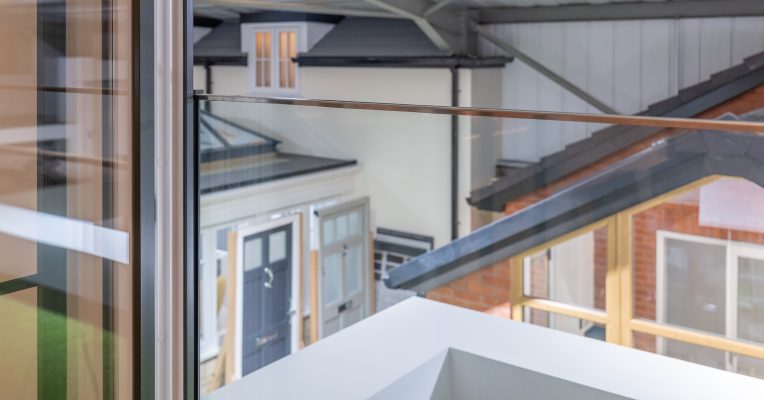
The way a balustrade is fixed is one of the most important decisions.
Glass can be held in base shoe channels, fixed with side-mounted clamps and posts, or attached using specialist fixings into suitable structural elements. The right method depends on where the balustrade is going, what it is fixing into and how the finished floor or external surface is designed. This needs to be discussed early.
A balustrade fixed into a concrete structure, a timber deck, a steel frame, a staircase stringer or a balcony edge may all require different fixing details. The finished floor level also matters, especially where channels are to be recessed or where drainage, paving or internal flooring still needs to be completed.
This is not a detail to leave until the glass arrives on site. The structure needs to be suitable before the balustrade can be fitted properly.
Glass type and safety specification
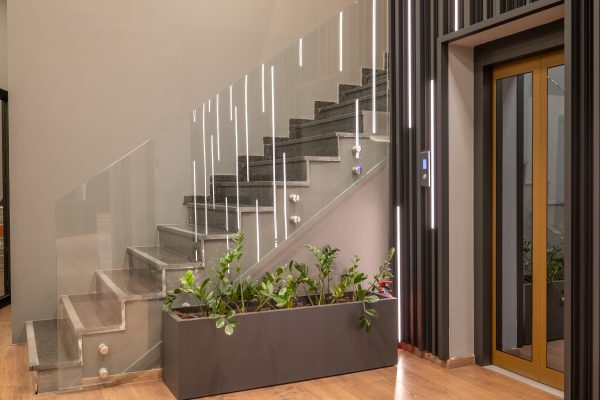
Balustrade glass needs to be specified for safety, not just appearance. For guarding where there is a risk of falling, the glass specification must be appropriate for the location, the fixing method and the loads it needs to resist. In many domestic balustrade applications, toughened laminated safety glass is commonly used because the laminate helps retain the glass if one pane is damaged.
This is not an area to value-engineer without proper advice. A balustrade is there to protect people. The glass thickness, laminate, edge detail, fixing method and supporting structure all work together. The correct specification should be confirmed for the individual project rather than chosen from appearance alone.
Indoors and outdoors are different specifications. An internal staircase balustrade is not the same specification challenge as an external balcony or terrace balustrade. Inside the home, the focus may be on appearance, light, handrail choice, cleaning and how the balustrade works with stairs, landings or open-plan spaces.
Outside, the product also has to deal with weather exposure, UV, wind, rainwater, fixings, drainage and long-term durability. External clamps, posts, handrails and fixings need to be suitable for outdoor use. Indoor components should not simply be used outside because they look similar. This is one of the ways lower-quality balustrade installations can go wrong. The system may look fine when first installed, but the wrong hardware or poor fixing detail can create problems later.
Height and Building Regulations
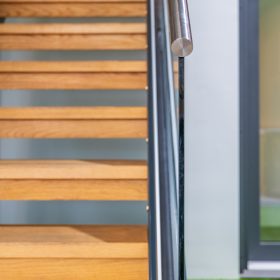
Balustrades and Juliet balconies need to meet Building Regulations Document K and Code of practice (BS6180). In simple terms, guarding is required where there is a risk of falling from stairs, landings, balconies, roof edges, terraces or similar areas. For single family dwellings, internal stairs, landings and edges of internal floors are commonly designed with guarding at 900mm minimum height. External balconies, including Juliet balconies, are commonly designed at 1100mm minimum height.
There are also requirements around openings and climbability, particularly where children may use the building. For example, guarding should normally be designed so that a 100mm sphere cannot pass through openings, and horizontal rails that make climbing easier should be avoided. The exact requirement depends on the location and project, so it should always be checked as part of the design and installation process.
A product that is easy to get wrong on your own
Glass balustrades sit between glazing, structural fixing and Building Regulations. That is why we prefer to talk them through properly rather than ask homeowners to choose from a brochure alone. The product has to look right, but it also has to fix correctly, meet the required safety standard and suit the way the space will be used.
If you are planning a staircase, landing, raised terrace, balcony or Juliet balcony as part of a wider glazing project, bring the drawings into the CBP showroom or speak to us early in the process. We can help work out the right combination of glass, fixings and hardware for the space. We have examples of both Glass Juliet and Q-Railing balustrades in our Corsham Showroom.