
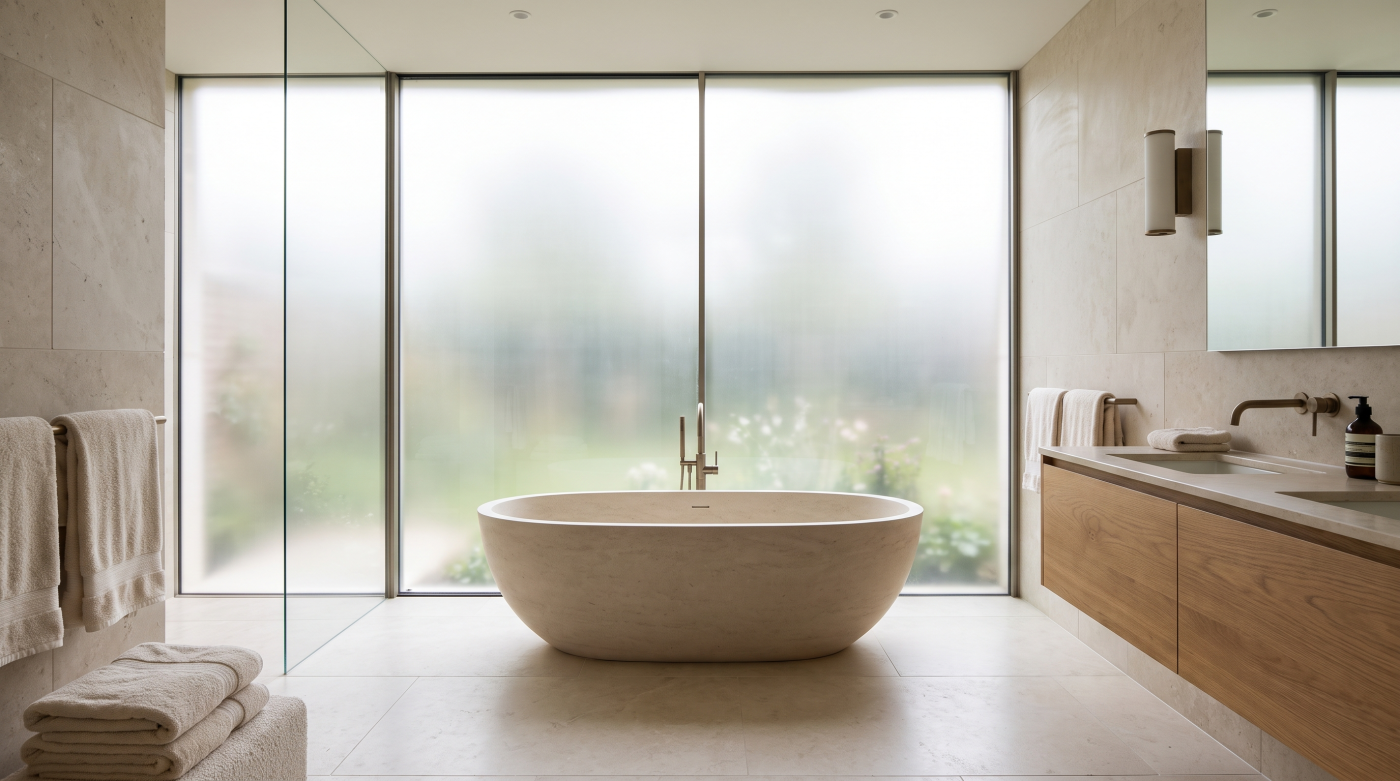
Privacy Through Glass Changes Between Day and Night
A glazed room can feel surprisingly private during the day.
Then darkness falls, the lights come on, and the relationship can change completely.
This happens because privacy through glass depends heavily on the relative brightness on either side of it.
During daylight, the outside environment is often considerably brighter than the interior. That bright external scene can create strong reflections on the outer surface of the glazing, making it more difficult for someone outside to see clearly into the room.
From inside, meanwhile, occupants may still enjoy a good view out.
It can feel like the glass is providing privacy.
But the glass has not suddenly become one-way.
After sunset, the lighting relationship can reverse. The garden or street becomes dark while the illuminated interior becomes the brighter side. Someone outside may now be able to see into the room much more easily, while the occupants looking out see stronger reflections of their own interior.
This is why terms such as “one-way glass” need to be treated carefully in residential design.
Reflective and some solar-control glazing can create greater external reflectivity under particular daylight conditions, but that should not automatically be interpreted as reliable privacy throughout the day and night.
Weather can alter the effect too. Overcast conditions, external lighting, neighbouring properties and the position of the observer can all influence how exposed an interior appears.
For rooms where privacy genuinely matters—particularly bedrooms, bathrooms and street-facing living spaces—a separate night-time strategy may therefore be required.
That could involve curtains, blinds, external screening, permanent obscure glazing or, in selected applications, switchable privacy glass.
The important principle is simple:
Privacy is not just a property of the glass. It is a relationship between light, viewing position and the spaces on either side of it.
So never assess a glazing privacy strategy only on a bright afternoon.
Ask what happens at 8pm on a winter evening, when the interior lights are on and the world outside is dark.
That is often when the true privacy performance of the design becomes apparent.
Start With Sightlines Before You Start With Privacy Glass
Before choosing obscure, reflective or switchable glass, ask a more fundamental question:
Who can actually see through the opening?
Privacy is often treated as a glass-specification problem when it may really be an architectural one.
Start by mapping the important sightlines around the property.
Can someone walking along the pavement see directly into the living room? Does a neighbouring first-floor window overlook the kitchen? Can visitors approaching the front door see through a glazed entrance into the main living space?
Ground levels matter too.
A neighbouring property positioned uphill can have completely different sightlines from one at the same level. Similarly, a garden that feels secluded while seated may become surprisingly exposed when someone stands close to a large glazed elevation.
Then consider the room behind the glass.
A kitchen does not necessarily require the same privacy as a bedroom. A bathroom may need permanent screening, while a living room might need privacy only during particular times of day.
Once those requirements are understood, relatively simple architectural decisions can become powerful.
Raising a sill can interrupt a direct sightline while retaining daylight. High-level or clerestory glazing can illuminate a room without creating an exposed view. Deep reveals, angled openings, carefully positioned solid wall sections and changes in window position can all influence what is visible from outside.
Sometimes moving an opening by a relatively small distance can remove a direct line of sight altogether.
That can be a cleaner solution than specifying specialist privacy glass across an entire elevation.
The objective is not necessarily to stop people seeing the building.
It is to control what they can see into and from where, while preserving the views and daylight that made the glazing desirable in the first place.
So before asking:
“What privacy glass should we use?”
draw the sightlines.
Because the most elegant privacy solution may not be a coating, blind or electrical glass system.
It may simply be putting the opening in a better place.
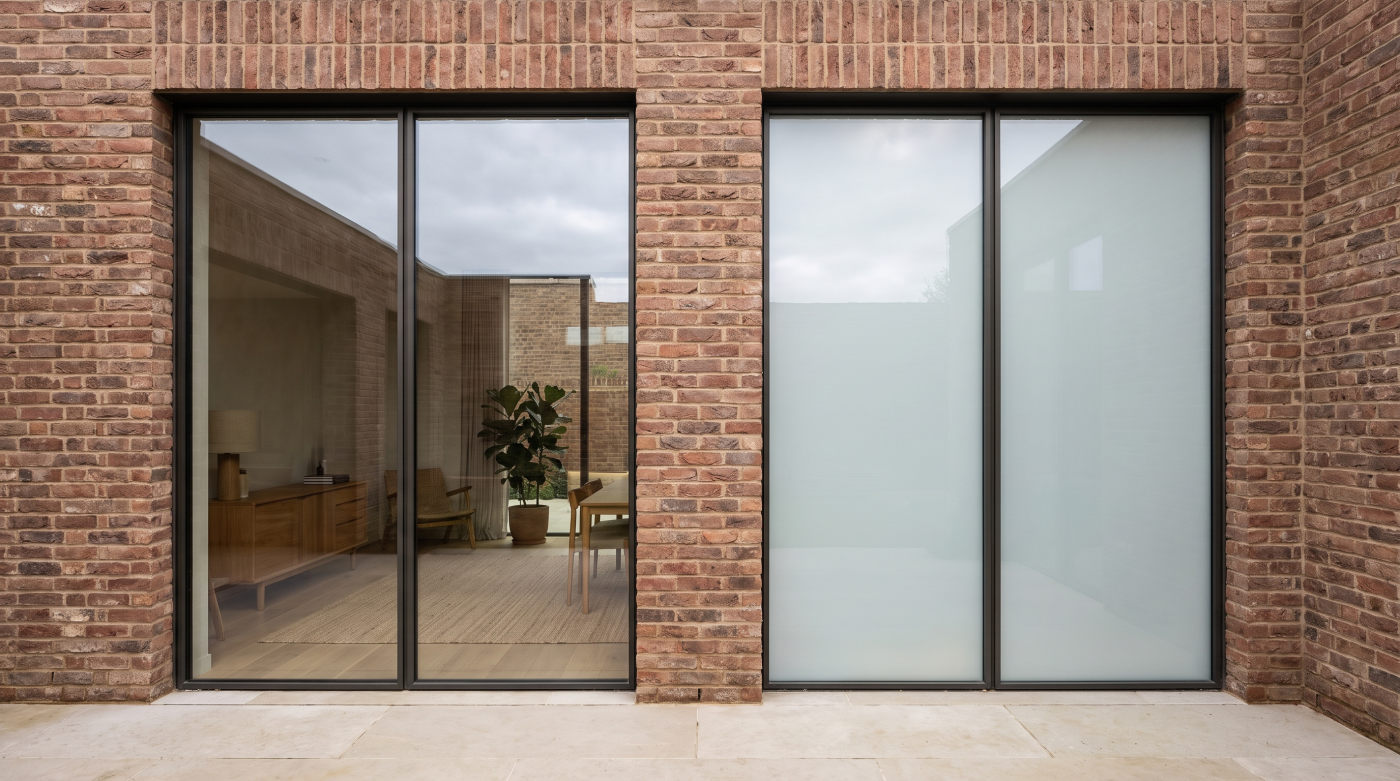
Landscaping and External Screens Can Preserve the Glass
If privacy is the problem, changing the glass is not always the best solution.
Sometimes it is better to change what someone outside can see before their sightline ever reaches the glazing.
This is where landscaping and external screening can become powerful architectural tools.
A strategically positioned garden wall, slatted screen, pergola or area of planting can interrupt views towards a glazed elevation while allowing the glass itself to remain clear. The occupants retain daylight and a connection with the garden without feeling unnecessarily exposed.
The key is to screen the sightline, not necessarily the entire opening.
For example, a neighbouring window may overlook one particular section of a large sliding elevation. A carefully positioned external screen could interrupt that view without enclosing the whole garden or sacrificing the wider landscape beyond it.
Planting can achieve something similar.
Evergreen species may provide more consistent year-round screening, while deciduous planting changes substantially between summer and winter. Mature height, density, maintenance and the eventual position of the planting all need to be considered rather than judging privacy from how a newly planted garden looks on completion.
Distance matters too.
A screen positioned close to the observer, boundary or glazing can produce a very different visual effect from one placed elsewhere in the landscape.
External privacy measures can sometimes perform more than one job.
Depending on their position and design, screens, planting and architectural structures may also contribute to solar shading—particularly valuable where a highly glazed elevation has both privacy and overheating concerns.
The best solution may therefore involve coordination between the architect, landscape designer and glazing specialist rather than treating the window as an isolated component.
There will, of course, be projects where permanent obscure or switchable glass remains appropriate. Planning, heritage and other project-specific constraints may also influence what can be introduced externally.
But specialist glass should not automatically be the starting point.
If the objective is to preserve transparency, first ask whether the unwanted view can be controlled outside the glass.
Because sometimes the best way to keep a window beautifully clear is not to alter the window at all.
It is to design the landscape around it more intelligently.
Obscure, Etched and Patterned Glass: Privacy Without a Blind
Not every window needs a view.
In bathrooms, entrance areas, stairwells and some street-facing spaces, the priority may be to bring natural light into the room while preventing a clear line of sight through the glass.
This is where permanent privacy glazing can be particularly effective.
Obscure, frosted, etched and patterned glass all approach privacy differently, but the underlying objective is similar: disrupt the view through the pane while continuing to admit useful daylight.
For the right opening, that simplicity is a major advantage.
There is no blind to lower every evening and no electrical system to activate. The privacy is effectively built into the glazing itself.
But permanent privacy is also its limitation.
If an obscure pane prevents somebody outside seeing into a bathroom, it also prevents the occupant enjoying a clear view out when privacy is not required. That makes this type of glass particularly appropriate where daylight has greater value than the view.
A bathroom window overlooking a neighbouring property is an obvious example. Entrance-door sidelights, stairwells and high-level windows can present similar opportunities.
The degree of obscuration matters too.
Not every privacy glass provides the same visual effect. Shapes, movement, colours or silhouettes may remain perceptible depending on the particular product, lighting conditions and distance from the glass.
For that reason, privacy should not be judged from a small website image alone. Where the appearance matters, viewing an appropriate physical sample—and understanding how it behaves under realistic lighting—can be valuable.
The treatment also needs to sit within the wider glazing specification. Thermal performance, safety requirements, glass construction and system compatibility remain separate considerations and should be verified for the proposed product.
Permanent privacy glass is therefore not the answer for every exposed window.
But where a space consistently needs light without a clear view, it can be one of the simplest and most architecturally integrated solutions available.
The key is using it where losing the view is not really a loss at all.
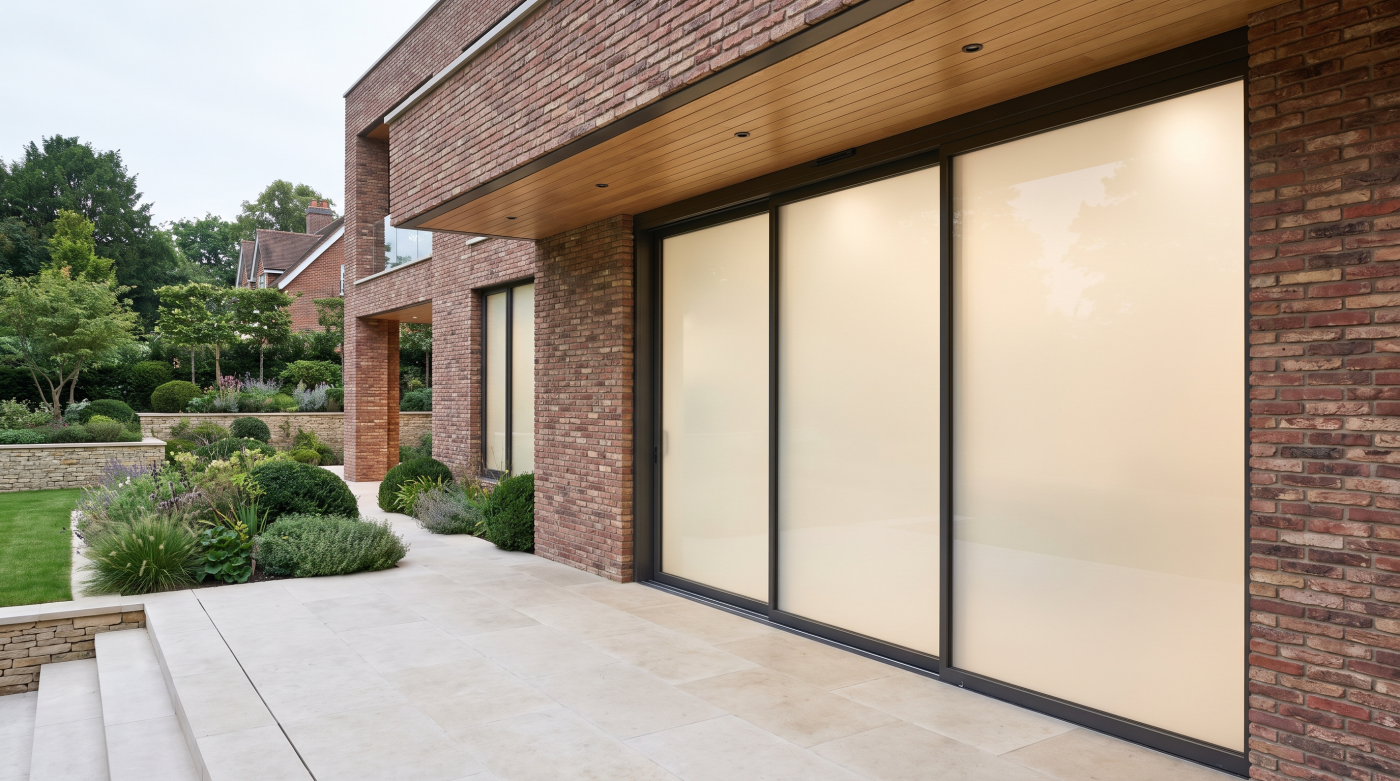
Switchable Privacy Glass: Where It Makes Sense—and Where It Doesn’t
Some windows need privacy all the time.
Others need something more complicated:
a clear view at one moment and privacy at another.
That is where switchable privacy glass becomes interesting.
Depending on the technology, switchable glazing can change between different visual states, allowing an opening to remain relatively transparent when the view is wanted and provide greater visual screening when privacy becomes the priority.
That can be particularly useful where permanent obscure glass would sacrifice too much.
Imagine a bathroom overlooking a private landscape, a bedroom with an exposed elevation, an entrance area visible from the street or an internal glazed partition separating two spaces. In each case, there may be genuine value in preserving transparency some of the time while being able to remove the clear view when required.
But switchable glass should not be treated as invisible technology with perfect privacy.
The appearance of the clear state can differ from conventional clear glazing. Depending on the system, haze may be noticeable, particularly at certain viewing angles. The privacy state may obscure detail without necessarily creating complete visual opacity, and light, movement or silhouettes may still be perceptible.
Control requirements matter too.
Some technologies require electrical power to maintain a particular state, meaning wiring, switching and potentially smart-home integration need to be considered before installation—not after the glazing has arrived.
Cost and complexity are also greater than simply installing conventional clear or obscure glass.
Pane dimensions, insulated-glass compatibility, controls, replacement implications and the specific behaviour of the technology all need to be understood. For important architectural applications, reviewing an appropriate full-size sample can be far more informative than relying on photographs or videos.
This is why switchable privacy glass works best when it solves a specific architectural contradiction.
If a bathroom window never needs a view, permanent obscure glass may be simpler. If a living room only needs privacy after dark, blinds or curtains may provide more practical control.
But where the same opening genuinely needs to perform two opposing jobs—
be transparent when openness matters and private when it doesn’t—
switchable glass can become a powerful design tool.
The technology should earn its place in the architecture, rather than being specified simply because it can change state.
Why “One-Way Glass” Is Usually the Wrong Privacy Brief for a Home
One of the most appealing ideas in residential glazing sounds almost perfect:
“I want to see out, but I don’t want anyone to be able to see in.”
The problem is that so-called one-way glass does not provide permanent one-way privacy under every lighting condition.
What people often have in mind is highly reflective glazing. During daylight, when the exterior is brighter than the interior, the external surface can appear strongly reflective. Someone outside may find it difficult to see into the room, while the occupants retain a view out.
That can create a convincing privacy effect.
But it depends heavily on the difference in brightness between the two sides.
At night, the relationship typically reverses. The interior lights come on while the garden, pavement or neighbouring property becomes darker. The person outside may then be able to see into the illuminated room far more easily, while the homeowner looking through the glass sees stronger reflections of the interior.
In other words, the privacy effect can disappear precisely when occupants expect privacy most.
This is also why solar-control glass and privacy glass should not automatically be treated as the same thing.
Some solar-control coatings can create a more reflective external appearance, but their primary purpose is managing solar energy. Any daytime privacy effect needs to be understood in the context of the actual product and lighting conditions rather than assumed to provide permanent screening.
Highly reflective glass can also change the architecture. External appearance, colour, reflectivity and the quality of the view from inside all deserve consideration.
A better design brief therefore starts with the privacy requirement itself.
Who should not be able to see in? From where? At what time of day? And does the homeowner ever need a completely clear view through the same opening?
The solution might then be clear glazing combined with landscaping, an architectural screen, blinds or curtains. In selected situations, obscure or switchable privacy glass may be more appropriate.
Because if privacy genuinely matters, relying on daytime reflectivity alone is a fragile strategy.
Design the glazing for the moment the lights come on—not just for how private it looks during the day.

The Best Privacy Strategy Often Uses More Than One Layer
Privacy is rarely best solved by asking one piece of glass to do everything.
A sophisticated home may need daylight, clear views, night-time privacy, solar control and visual openness—sometimes from the same elevation.
Trying to achieve all of that through a single specialist glass specification can create unnecessary compromises.
A better approach is often to design privacy in layers.
The architecture can provide the first layer by controlling the most important sightlines. Window position, sill height, solid wall sections, deep reveals and the orientation of openings can prevent unwanted views before additional privacy measures are required.
Outside, landscaping and architectural screens can provide another layer. Strategic planting might shield a neighbouring window while preserving the longer view beyond it. A slatted screen could protect a seating area while potentially contributing to solar shading as well.
The glass can then perform the job appropriate to each opening.
Clear glazing can remain where the view matters. Permanent obscure glass can provide privacy where the view has little value, such as selected bathrooms or entrance areas. Switchable glass may be justified where the same opening genuinely needs to alternate between transparency and screening.
Then there is occupant-controlled privacy.
Curtains and blinds remain remarkably useful because privacy requirements change. A garden-facing living room might remain completely open throughout the day but need screening once the interior lights come on. A bedroom may require both daylight control and privacy at different times.
Different rooms therefore deserve different strategies.
The bathroom, bedroom, kitchen and main living space do not need to share the same solution simply because they belong to the same house.
Coordination matters, particularly where several glass types or coatings are being considered. Differences in colour, reflectivity and appearance across an elevation should be understood before the specification is finalised.
This is where architects, interior designers, landscape designers and glazing specialists can each influence a different part of the solution.
The result may actually involve less specialist privacy glass, not more.
Because the strongest privacy strategy is usually not a single product.
It is a carefully designed series of layers that allows the architecture to remain open where openness adds value—and become private precisely where and when the occupants need it.
The Privacy Checklist Before You Finalise the Glazing
Before choosing privacy glass, blinds or screening, go back to the purpose of each opening.
What is this piece of glass actually supposed to achieve?
Does it frame an important view? Bring daylight into a bathroom? Connect a living room with the garden? Illuminate a staircase? The value of transparency determines how much you should be prepared to sacrifice for privacy.
Then establish who can see towards it.
Look beyond immediate neighbours. Consider pavements, roads, approaching visitors, neighbouring upper floors and changes in ground level. Test the sightlines from both seated and standing positions.
Next, determine when privacy is actually required.
A bathroom may need permanent screening. A bedroom may need privacy predominantly at night. A garden-facing living room could remain completely transparent during the day but feel exposed once the lights come on after dark.
That distinction can determine the solution.
Could the opening itself be repositioned? Would raising the sill or using high-level glazing remove the unwanted sightline? Could a wall, screen or carefully positioned planting provide privacy while allowing the glass to remain clear?
If not, consider what the glass needs to do.
Permanent obscure glazing can work extremely well where daylight matters but the view does not. Switchable privacy glass may be appropriate where the same opening genuinely needs clear and private states. Reflective glazing should not be assumed to provide reliable one-way privacy throughout changing lighting conditions.
Then consider occupant-controlled measures.
Will curtains or blinds still be needed at night? Can they be integrated cleanly into the architecture rather than added reluctantly after occupation?
Where several glass types are proposed, review their colour, reflectivity and appearance together. For specialist privacy products, appropriate samples and verified manufacturer information can help establish what occupants will actually see.
Finally, test every important opening against two scenarios:
A bright Sunday afternoon when the occupants want the house completely open to the garden.
And:
A dark winter evening when the lights are on and they want to relax without feeling visible from outside.
A successful privacy strategy should have a convincing answer to both.
Because the objective is not maximum transparency or maximum screening.
It is controlled openness—giving people the daylight and views that make architectural glazing special, while allowing their home to feel private precisely when they need it to.