
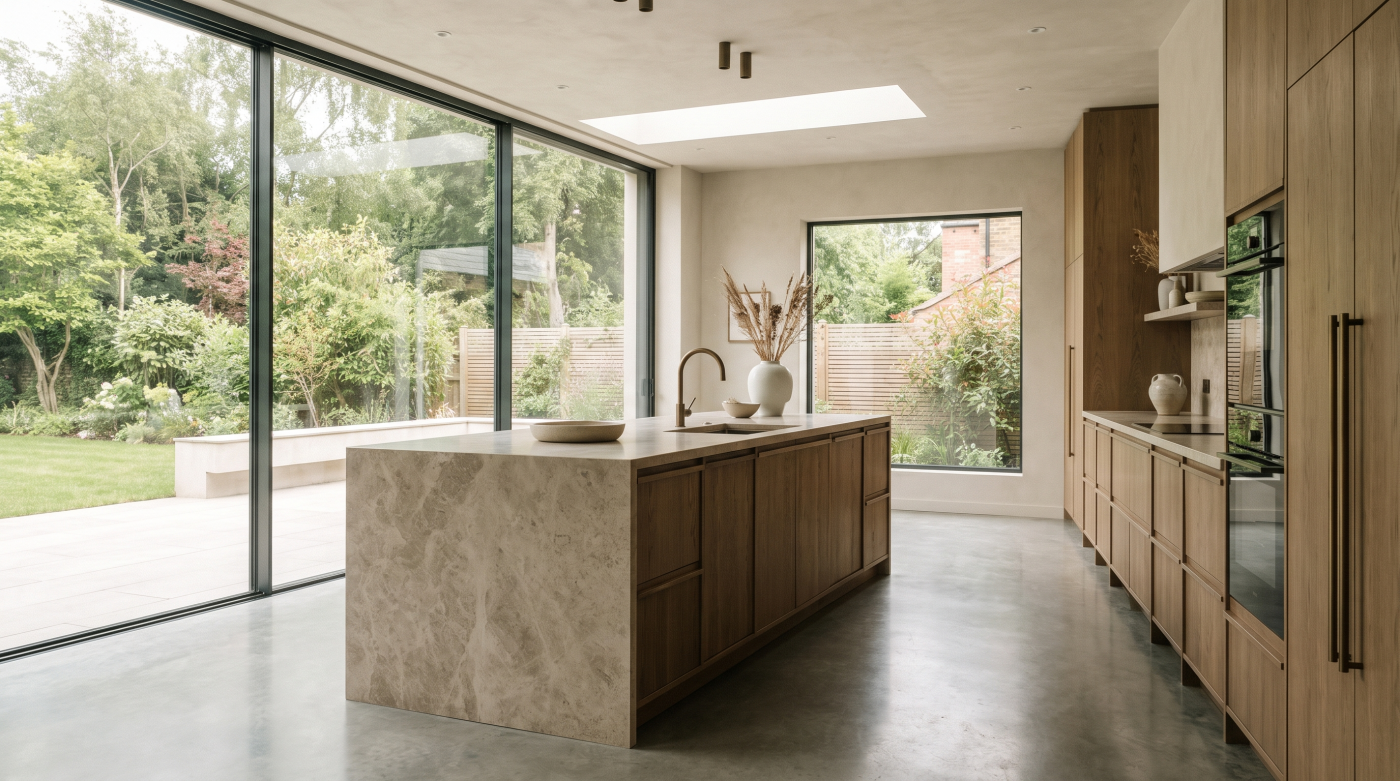
The Fundamental Difference: Direct Sun Versus Diffuse Daylight
North- and south-facing windows can use exactly the same glass and still create very different conditions inside a home.
The reason begins with the path of the sun.
In the UK, the sun travels predominantly across the southern part of the sky. A south-facing elevation therefore has much greater opportunity to receive direct sunlight during the day, although the amount that actually reaches the glass changes with the season, time of day and surrounding environment.
A north-facing elevation generally receives much less direct sunlight.
But that does not mean a north-facing window provides poor daylight.
Direct sunlight and daylight are not the same thing. Light is scattered through the atmosphere and reflected by the landscape, neighbouring buildings and other surfaces. North-facing glazing can therefore provide substantial diffuse daylight without receiving the same level of direct solar exposure as glazing facing south.
That difference has important consequences.
When direct sunlight passes through south-facing glass, it can introduce solar energy into the room as well as light. During colder periods, some of that solar gain may be useful. During warmer conditions, particularly where the glazed area is large, the same process can contribute to overheating.
North-facing glazing has a different balance. It may provide excellent natural light and views while receiving less useful direct solar gain, placing greater emphasis on controlling heat loss through the window.
Season matters too. Solar altitude and day length change substantially between winter and summer, altering how sunlight reaches the building.
And orientation alone never tells the complete story.
Trees, neighbouring buildings, hills, overhangs and other obstructions can dramatically change actual exposure.
So north versus south is not simply dark versus bright.
It is largely a difference between two types of solar relationship: one elevation with greater exposure to direct sunlight and another typically dominated by softer, diffuse daylight.
Understanding that distinction is the foundation for almost every glazing decision that follows.
South-Facing Glass Can Give You Something North-Facing Glass Cannot: Useful Solar Gain
Heat entering through glass is often discussed as though it is automatically a problem.
It isn’t.
During colder periods, solar energy entering through south-facing glazing can make a useful contribution to the internal environment. Sunlight passes through the glass, reaches internal surfaces and introduces energy into the building.
In the right circumstances, that is useful solar gain.
South-facing glazing has greater potential to take advantage of this effect because of the sun’s path across the southern part of the UK sky. During winter, when the sun sits lower, direct sunlight can penetrate further into south-facing rooms.
North-facing glazing generally has much less opportunity to do the same.
This introduces an important distinction between two numbers commonly encountered when specifying high-performance glass.
The Ug-value relates to heat transfer through the glazing. The g-value, or solar factor, describes the proportion of solar energy transmitted through the glazing under the relevant measurement method.
They answer different questions.
A low Ug-value can help reduce heat loss, while the g-value helps us understand how the glazing interacts with incoming solar energy. A good specification therefore cannot always be reduced to pursuing the lowest number available for every characteristic.
For example, aggressively limiting solar transmission across every south-facing window may reduce unwanted summer gains—but it can also reduce solar gains that could have been useful during cooler conditions.
That does not mean maximising solar gain is automatically desirable either.
Glazed area, room use, shading, building performance and overheating risk all influence the appropriate balance. There is no universal g-value that every south-facing window should achieve.
The objective is more intelligent than simply letting heat in or keeping it out.
South-facing glass gives the building access to solar energy.
The design challenge is deciding how much of that energy is useful, when it is useful, and how the building will control it when it isn’t.
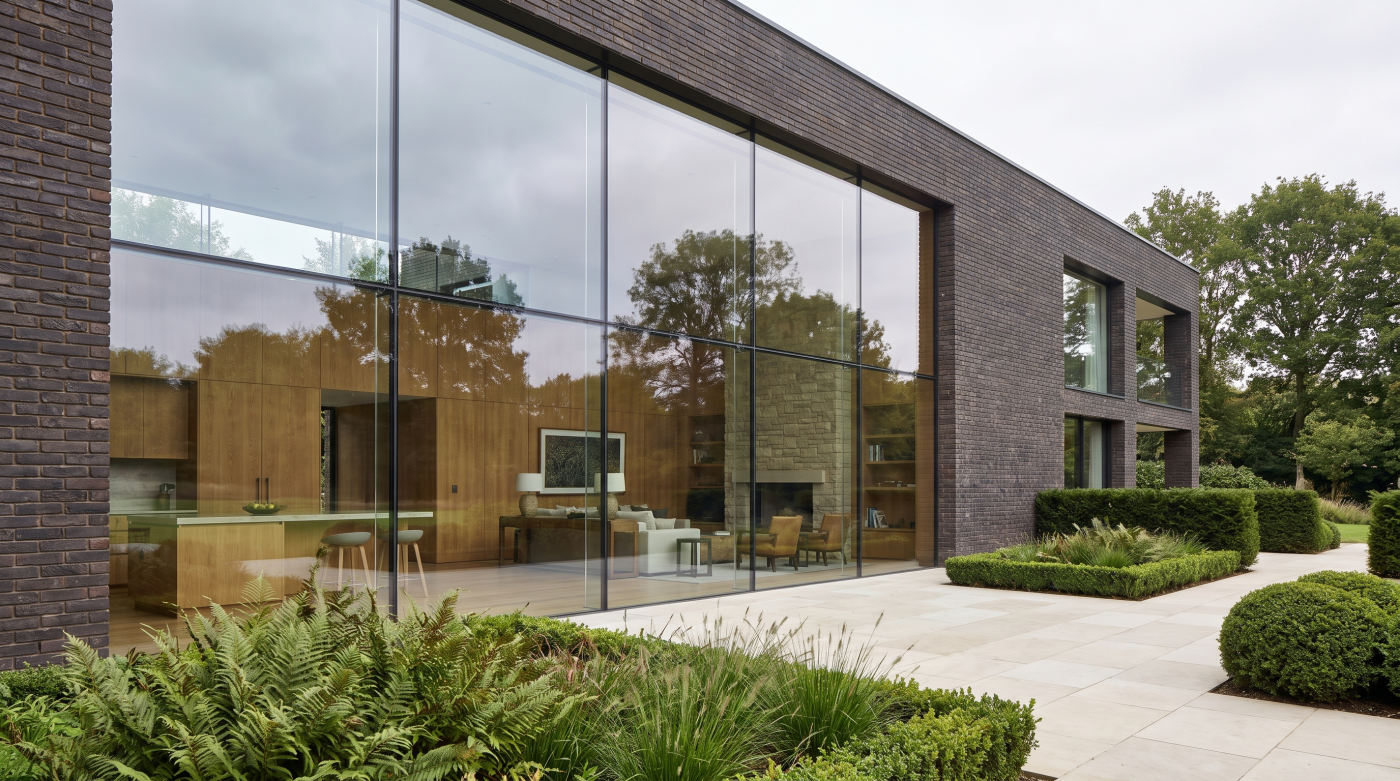
The Same South-Facing Glass Can Become an Overheating Problem
The solar energy that makes south-facing glazing useful during colder weather does not disappear when the building no longer needs it.
That is where the problem begins.
During warmer periods, sunlight passing through a large south-facing glazed elevation can introduce substantial solar energy into the room. If that heat arrives faster than the building can dissipate it, internal temperatures can become uncomfortable.
Highly insulated and airtight homes deserve particular attention.
A building designed to reduce unwanted heat loss can also become very effective at retaining unwanted heat. Add solar gains from large areas of glass to internal gains from people, cooking, lighting and appliances, and summer comfort can become a significant design consideration.
The solution is not necessarily to abandon south-facing glazing.
Architecture can do some of the work.
The higher angle of the summer sun can make appropriately designed external overhangs useful on certain south-facing elevations. They can help shade the glass when solar exposure is less desirable while potentially allowing lower-angle winter sunlight to reach further into the building.
Solar-control glass can form another part of the strategy, reducing the proportion of solar energy transmitted through the glazing. Ventilation and appropriate opening strategies may also help remove accumulated heat.
Internal blinds are valuable for controlling glare and improving occupant comfort, but they are not thermally equivalent to stopping solar energy before it passes through the glazing.
Most importantly, these measures should be considered together.
A large south-facing elevation should not be designed first with the assumption that “high-performance glass” can solve overheating later. Low thermal transmittance and solar control are different aspects of glazing performance.
For substantially glazed homes, appropriate overheating analysis can help establish whether the combination of glass area, orientation, shading and ventilation is likely to work.
Because the characteristic that makes south-facing glazing attractive in January can become its greatest challenge in July.
The objective is not to eliminate solar gain. It is to design the building so that useful winter energy does not become unwanted summer heat.
North-Facing Glass Has the Opposite Thermal Problem
If south-facing glazing often raises the question “How do we control solar gain?”, north-facing glazing tends to shift the conversation in the opposite direction.
How do we reduce heat loss while preserving the daylight and view that made us want the glass in the first place?
In the UK, north-facing glazing generally receives less direct solar radiation. That means there is typically less opportunity for useful solar gain to offset heat transfer through the window during colder conditions.
As the glazed area increases, that balance becomes increasingly important.
A large north-facing picture window or sliding elevation may provide an exceptional connection to the landscape, but it also represents a substantial part of the building’s thermal envelope. The thermal performance of the glazing and complete window or door system therefore deserves careful attention.
This is where elements such as low-E coatings, appropriate insulated-glass cavities, warm edge spacers and double or triple glazing can contribute to the overall strategy.
But once again, the headline glass figure tells only part of the story.
A strong Ug-value describes the thermal performance of the glazing, while the complete window or door also includes the frame and glass-edge effects. For large architectural openings, understanding relevant whole-system performance can therefore be more useful than focusing solely on the centre of the pane.
Internal comfort matters too. Large areas of relatively cold internal glass can influence how comfortable occupants feel close to the elevation, even when the room’s air temperature appears acceptable. Improving glazing performance can help raise internal surface temperatures and reduce that effect.
None of this means north-facing glass should automatically receive the most insulating specification available.
Cost, daylight, appearance, glass weight, system capability and the wider building strategy still matter.
The objective is not to penalise north-facing glazing because it receives less sun.
It is to recognise that it has a different job.
South-facing glass often needs solar energy to be managed. North-facing glass often needs its architectural benefits to be preserved while heat loss is carefully controlled.
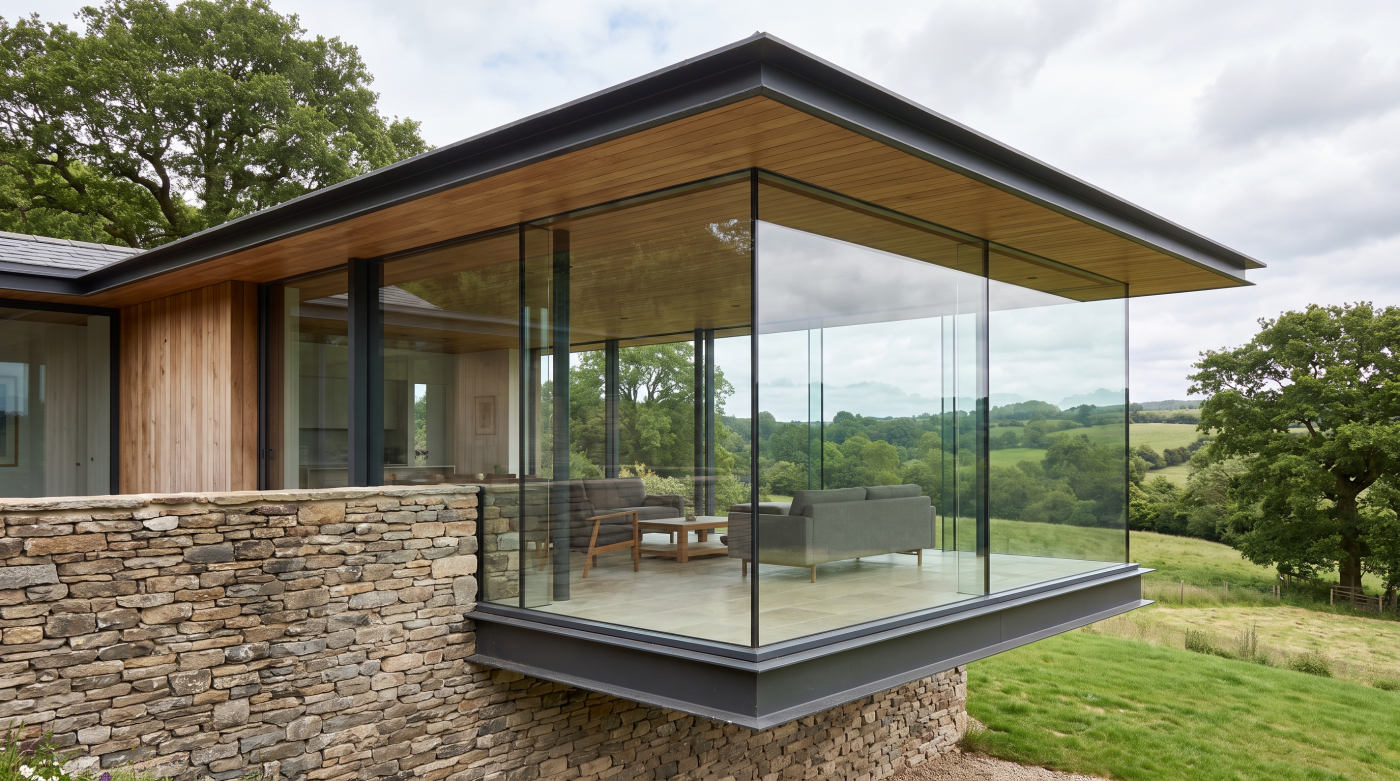
Why North Light Can Be Architecturally Beautiful
North-facing glazing is sometimes treated as the poor relation of south-facing glass because it receives less direct sunlight.
Architecturally, that can be exactly what makes it valuable.
Rather than experiencing the stronger changes created by direct sun moving across an elevation, north-facing windows can provide softer, more diffuse daylight. The character of the light can feel calmer and more consistent, particularly in spaces where harsh sunlight or pronounced glare would be undesirable.
This quality has long made north light valuable in spaces where even illumination matters.
In a contemporary home, the same principle can benefit kitchens, living spaces, circulation areas, home studios and other rooms where natural light is important but direct sunshine is not necessarily the objective.
Then there is the view.
The orientation of a home is not chosen solely around thermal optimisation. Sometimes the landscape, garden or architectural focal point sits to the north. In that situation, deliberately limiting the glazing simply because the elevation receives less solar gain could sacrifice one of the project’s greatest assets.
A large north-facing opening can frame countryside, woodland or a carefully designed garden while filling the interior with diffuse daylight.
The challenge is to achieve that experience without ignoring thermal performance.
As the glass area increases, appropriate glazing and whole-window performance become increasingly important. Visible light transmission may also deserve consideration where maximising daylight is part of the architectural objective.
Even choices such as glass clarity can influence the experience on projects where colour neutrality and an uninterrupted connection to the landscape are particularly important.
This is why north-facing should never become shorthand for undesirable glazing.
A window is doing more than transferring energy through a building envelope. It is creating daylight, framing views and influencing how a room feels throughout the day.
South-facing glass may provide more direct sunshine.
North-facing glass can provide something different:
quiet, consistent light and a connection to the landscape without requiring direct sun to make the architecture feel exceptional.
Should North and South Elevations Use Different Glass?
If north- and south-facing glazing are dealing with different environmental conditions, an obvious question follows:
Should they actually use different glass specifications?
Sometimes, yes.
A large south-facing elevation may require careful control of solar gain, while a north-facing elevation may place greater emphasis on reducing heat loss. Using exactly the same glass throughout the building can therefore be convenient without necessarily being optimal.
The distinction becomes clearer when looking at two different performance characteristics.
The Ug-value relates to thermal transmittance through the glazing. The g-value relates to how much solar energy is transmitted through it. On a north-facing elevation with relatively little direct solar exposure, strong thermal insulation may be a major consideration. On a heavily exposed south-facing elevation, solar performance may require much closer attention.
That could lead to different glass build-ups or coatings being considered for different elevations.
But there is a complication: glass has an appearance as well as a performance.
Different coatings can influence colour, reflectivity and visible light transmission. If several specifications are used around the same property, particularly where panes can be viewed together, those visual differences need to be understood before the glass is ordered.
Complexity has consequences too.
Multiple glass specifications create a more detailed glass schedule and increase the importance of accurate coordination between architect, glazing specialist, manufacturer and installer.
So differentiation should have a reason behind it.
If appropriate modelling shows that one glass specification provides the required thermal and solar performance across the building, standardising may be the sensible solution. If particular elevations experience substantially different conditions, treating them differently may produce a better-performing home.
The question is therefore not:
“What is the best glass for this house?”
It is:
“What does the glass on each elevation actually need to achieve?”
Using different glass on north and south elevations is not inconsistency when those elevations are solving different problems.
It is specification responding to architecture.
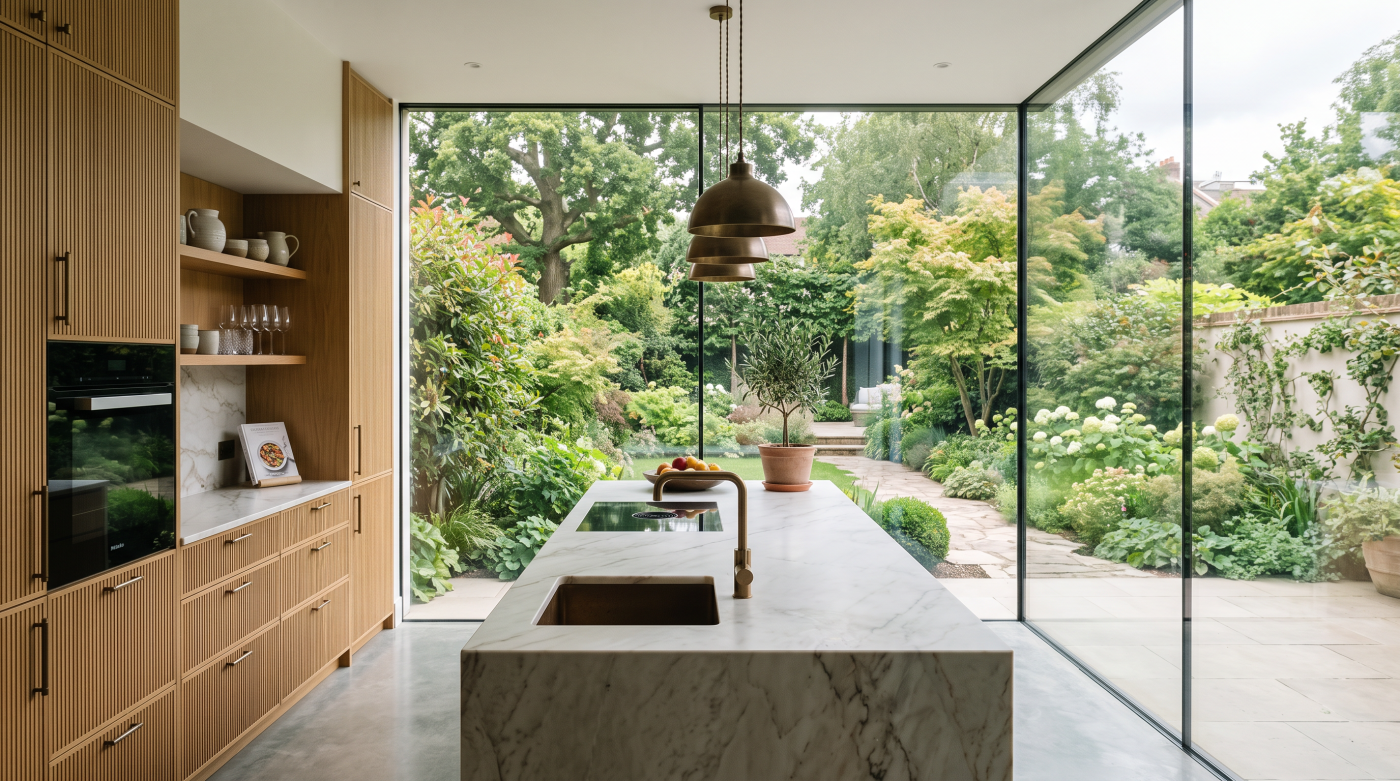
A Tale of Two Large Sliding Doors
Imagine two identical six-metre sliding doors on the same home.
They use the same frame system, have similar panel sizes and create the same amount of glass. One faces south. The other faces north.
On a product schedule, they might look almost identical.
In reality, they can be completely different design problems.
The south-facing slider may receive substantial direct solar exposure. During colder periods, some of that energy could be useful. During summer, however, the same large area of glass could introduce significant solar gain, making overheating, glare and shading important considerations.
The north-facing slider has a different job.
It may receive relatively little direct sunlight while providing soft daylight and an exceptional view. Here, the thermal performance of such a large opening can become particularly important because there is less useful direct solar gain to balance heat transfer through the glazing.
Scale amplifies both situations.
With a small window, orientation still matters. With several metres of floor-to-ceiling glass, the consequences of solar exposure and thermal performance become much more significant.
This is why selecting both doors from the same product brochure and assuming they should automatically receive identical glass misses part of the specification challenge.
The south elevation might require closer consideration of g-value, solar-control strategy and external shading. The north elevation might place greater emphasis on Ug and whole-system Uw performance.
That does not automatically mean the two doors should use different glass. Visual consistency, coating appearance, system capability and specification complexity all need to be considered. Appropriate modelling may show that one construction works well for both.
But that should be the result of analysis rather than assumption.
Ideally, these conversations happen while the architect still has choices available—not once the openings are fixed and the glass is being ordered.
Because two six-metre sliding doors can be the same product, the same size and part of the same house.
Turn one through 180 degrees, and you can fundamentally change what that glazing needs to do.
The North vs South Glazing Checklist
North-facing and south-facing glazing should not be treated as competitors.
Neither orientation is automatically better.
They simply present different opportunities and different constraints—and the glazing strategy should respond accordingly.
For south-facing glass, begin with solar exposure. How much direct sunlight actually reaches the opening? At what times of year? How large is the glazed area, and what happens in the room behind it?
Then consider whether useful winter solar gain is desirable and how unwanted summer gain will be controlled. Is there an architectural overhang? Could external shading be incorporated? Does the glass require particular solar-control characteristics? Is glare likely to become an issue?
For north-facing glass, the emphasis often shifts.
How important is the view? How much diffuse daylight does the opening provide? What thermal performance is required from such a large part of the building envelope? If the glazed area is substantial, how does the complete window or door perform rather than just the centre of the glass?
Across both elevations, consider the relationship between Ug-value, g-value and visible light transmission.
Then ask whether using different glass specifications would genuinely improve the design. If different coatings or build-ups are proposed, their appearance, reflectivity and colour consistency should also be reviewed.
Room use matters throughout.
A bedroom, kitchen, home office and open-plan living space can respond very differently to the same sunlight because they are occupied at different times and in different ways.
For highly glazed or performance-sensitive projects, appropriate thermal and overheating modelling can help test these decisions before the glass is ordered.
Ultimately, the checklist comes down to two different design briefs:
South-facing glazing:
How can we benefit from the sun when it is useful and control it when it is not?
North-facing glazing:
How can we maximise daylight and views while maintaining strong thermal performance?
Answer those questions separately.
Because north versus south is not about choosing the “better” orientation.
It is about recognising that glass facing in opposite directions is being asked to do fundamentally different jobs.