
Section 1: Start With How You Want to Live, Not Which Door Looks Better
The conversation surrounding bifold and sliding doors often begins with appearance. Homeowners compare frame profiles, opening styles and photographs of completed projects, hoping one system will clearly emerge as the superior choice. Architects, however, usually begin somewhere entirely different. Before discussing products, they first ask how the space is intended to be lived in. The answer to that question frequently determines which door system is most appropriate long before any brochures are opened.
This reflects an important principle of residential design: large glazed doors are not simply openings within a wall. They shape how people move through a home, how internal spaces connect with the garden and how rooms function throughout the changing seasons. Choosing between bifold and sliding doors is therefore less about selecting a product and more about deciding how the architecture should support everyday life.
For some households, the garden functions as an extension of the living space for much of the year. Children move constantly between indoors and outdoors, family meals spill onto the terrace during warmer evenings and entertaining often revolves around creating one continuous social space. In these situations, the ability to open a substantial section of the façade may become an important part of how the home is experienced. The architectural objective is not simply to maximise glazing, but to reduce the physical separation between inside and outside whenever conditions allow.
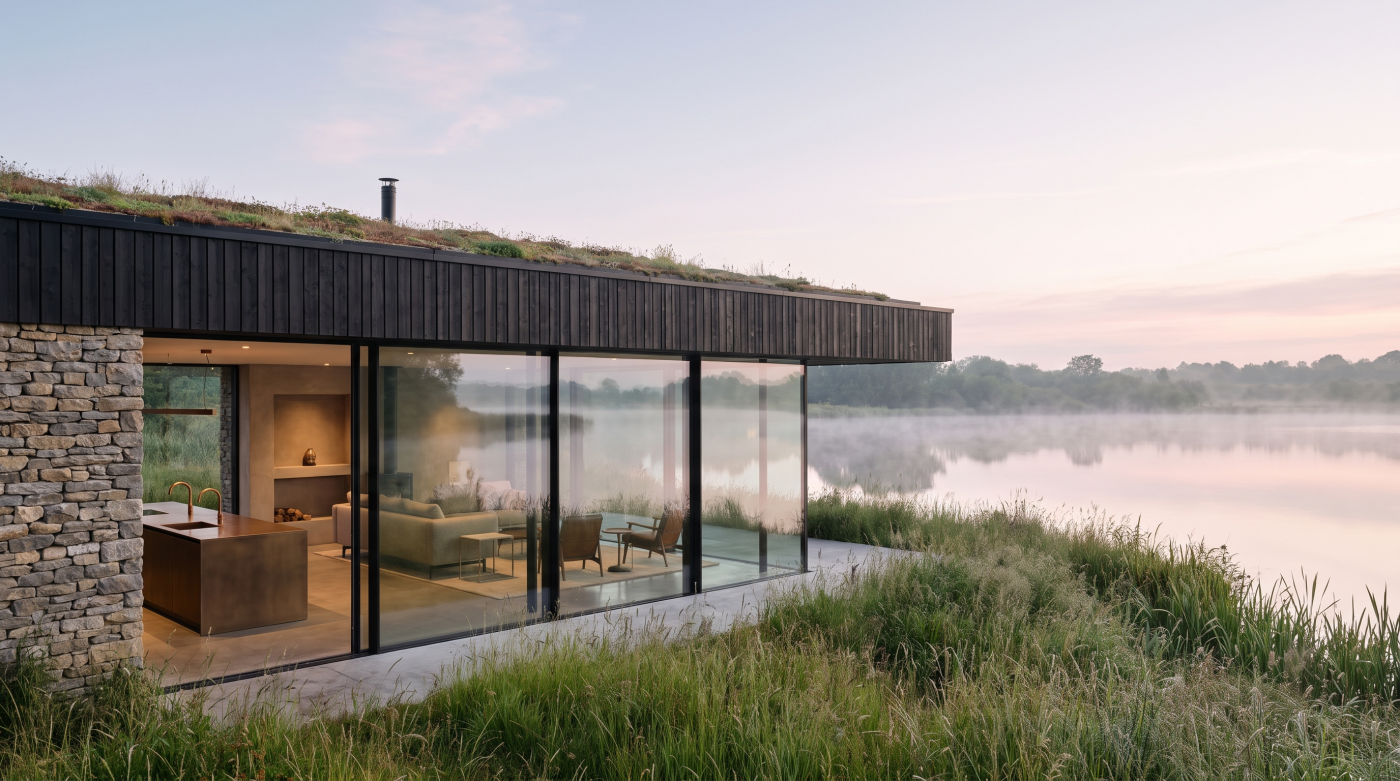
Other homeowners have different priorities. A property overlooking open countryside, a coastal landscape or a carefully designed garden may benefit more from preserving uninterrupted views throughout the year. In this case, the relationship with the landscape exists even when the doors remain closed. The quality of the outlook, the amount of natural daylight entering the room and the visual connection with the surroundings may become more valuable than creating the largest possible opening. The architecture supports observation rather than complete physical openness.
Furniture layout also deserves careful consideration, although it is often overlooked during the excitement of planning a renovation or self-build. Large glazed doors influence where dining tables, sofas, kitchen islands and circulation routes can comfortably sit within a room. Architects therefore think about how people will move through the space every day rather than considering the doors as isolated features. A beautifully designed glazing system achieves little if it compromises the way a room functions once occupied.
Seasonal living adds another dimension to the decision. During the height of summer, opening an entire elevation can transform the atmosphere of a home. Yet for much of the year, particularly in the UK climate, large glazed doors remain closed while continuing to frame views, admit daylight and contribute to thermal comfort. Understanding how often the doors are likely to be fully opened helps place their operating style into a more realistic context. The best solution is often the one that performs consistently throughout all four seasons rather than excelling only on warm summer afternoons.
These lifestyle considerations explain why architects rarely ask whether bifold or sliding doors are better. Instead, they ask how the building should behave on an ordinary Tuesday morning, during a family gathering at the weekend or throughout the quieter months of winter. The objective is to understand the routines that define everyday life because those routines ultimately shape the success of the architecture.
Seen from this perspective, the decision becomes much clearer. The right glazing system is not necessarily the one with the most impressive showroom demonstration or the latest design trend. It is the one that quietly supports the way the home is used every single day, strengthening the relationship between architecture, landscape and the people who live within it.
Section 2: Bifold and Sliding Doors Create Different Architectural Experiences
Although bifold and sliding doors are often compared as though they perform the same function, they create noticeably different architectural experiences. Both provide generous glazing, improved daylight and stronger connections with outdoor spaces, yet the way they achieve these outcomes is fundamentally different. Understanding those differences is often more valuable than comparing specifications or product features in isolation.
Sliding doors are designed around the idea of framing the landscape. Large panes of glass move horizontally behind one another, allowing the majority of the opening to remain uninterrupted by vertical framing. Even when the doors are closed—which is how they spend most of their time—they maximise views and natural light while maintaining a calm, minimal architectural presence. For many contemporary homes, this emphasis on transparency becomes one of the defining characteristics of the living space.
Bifold doors approach the relationship between inside and outside from a different perspective. Instead of prioritising uninterrupted views, they are designed to remove the physical barrier between the home and the garden as completely as possible. Multiple panels fold neatly to one or both sides, allowing almost the entire opening to become accessible. The emphasis shifts from looking through the glazing to moving freely between indoor and outdoor spaces, creating a very different way of experiencing the architecture.
These contrasting approaches influence the atmosphere of a room even when the doors are closed. Sliding doors encourage the eye to travel through expansive areas of glass towards the surrounding landscape, making gardens, courtyards or distant views feel visually connected to the interior throughout the year. Bifold doors, by comparison, introduce additional vertical frame lines because of their multiple folding panels. While these sightlines become almost irrelevant when the doors are fully opened, they remain a defining part of the façade during the majority of the year.
Ventilation also differs between the two systems. Bifold doors offer considerable flexibility because individual traffic doors can often be used independently or the entire system can be folded back when wider openings are required. This allows homeowners to adapt the level of ventilation according to changing weather conditions or the way the space is being used. Sliding doors provide a different experience, typically allowing one or more panels to slide open while the remaining glazed panels continue to frame the view. Neither approach is inherently better; they simply respond to different patterns of living.
The visual impact on the architecture is equally significant. Sliding systems often reinforce contemporary design by reducing visible framing and allowing the glazing itself to become the dominant element of the façade. This understated approach complements homes where simplicity, proportion and clean lines are central to the architectural language. Bifold doors, meanwhile, tend to express movement more visibly. Their multiple panels hint at the transformation that occurs when the entire opening is folded away, making flexibility part of the architectural character of the building.
Structural design can also influence the choice. Both systems are capable of spanning impressive openings, but the way those openings are organised within the architecture may lead naturally towards one solution or the other. Rather than treating the doors as interchangeable products, architects consider how each system contributes to the wider composition of the building, ensuring that the glazing supports the design rather than simply filling an opening.
Seen through this architectural lens, the comparison becomes much less about declaring a winner. Sliding doors and bifold doors solve different design problems and create different experiences of living within a home. The question is therefore not which system is superior, but which one best supports the relationship between the building, its surroundings and the people who will enjoy those spaces every day.
Section 3: Why Architects Sometimes Recommend Sliding Doors Instead
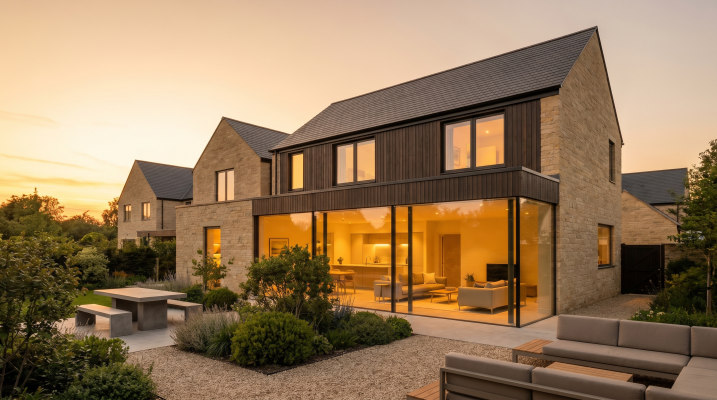
Sliding doors have become closely associated with contemporary residential architecture, but their popularity is not simply the result of changing design trends. Architects often recommend sliding systems because they support a particular architectural objective: allowing the landscape, natural light and surrounding environment to become integral parts of the living space while keeping the visual presence of the door itself to a minimum.
One of the defining characteristics of a sliding door is its ability to maximise glass while reducing visible framing. Large individual panels create broad, uninterrupted views that remain constant throughout the year, whether the doors are open or closed. For homes overlooking open countryside, coastal scenery, mature gardens or carefully designed landscapes, this continuous visual connection often becomes one of the building’s greatest strengths. Rather than drawing attention to the glazing, the architecture quietly frames the world beyond it.
This relationship with the landscape is particularly important because large glazed doors spend the vast majority of their lives in the closed position. While it is easy to imagine summer afternoons with every panel open, the reality of the UK climate means that for much of the year the glazing functions primarily as a window rather than an opening. Architects therefore place considerable value on how the doors perform visually when closed, recognising that this is how occupants experience them on most days.
Minimal sightlines also contribute to a calmer architectural language. Contemporary homes frequently rely on simplicity, restrained detailing and carefully controlled proportions. Sliding doors reinforce these principles by reducing interruptions within the façade and allowing natural light to move more freely through interior spaces. The result is often an environment that feels brighter, more spacious and more closely connected to its surroundings without relying on dramatic architectural gestures.
Large openings further strengthen the appeal of sliding systems. Modern engineering allows substantial panes of glass to move with remarkable ease, making it possible to create expansive elevations that would once have required considerably more framing. This capability allows architects to treat glazing as an architectural element rather than simply a functional opening, blurring the distinction between interior and exterior through transparency rather than physical openness alone.
Sliding doors also suit projects where the arrangement of furniture and circulation routes plays an important role. Because the panels move within their own plane rather than folding into the room or stacking to one side, they often provide greater flexibility when planning interior layouts and adjacent terraces. Dining tables, seating areas and circulation routes can frequently be positioned with fewer constraints, allowing the architecture to function naturally throughout the year rather than only when the doors are fully open.
This does not mean sliding doors are always the correct solution. They simply align particularly well with projects where uninterrupted views, abundant daylight and visual simplicity form central design priorities. A contemporary extension overlooking a landscaped garden, a coastal home framed by panoramic views or a rural self-build positioned to capture the surrounding countryside may all benefit from the quiet elegance that sliding systems provide.
Ultimately, architects recommend sliding doors not because they are inherently superior to bifolds, but because they solve a different architectural challenge. Their strength lies in making the boundary between inside and outside feel visually lighter while preserving the integrity of the building throughout every season. When uninterrupted views and a refined architectural language are the primary objectives, sliding doors often become the natural conclusion of the design process rather than the starting point.
Section 4: When Bifold Doors Make More Sense
While sliding doors are often celebrated for their minimal appearance and uninterrupted views, there are many projects where architects recommend bifold doors instead. This is not because one system outperforms the other, but because bifolds support a different way of living. Their greatest strength lies not in the view they frame when closed, but in the way they can transform a space when opened.
Perhaps the most obvious advantage of bifold doors is their ability to remove almost the entire barrier between the house and the garden. By folding neatly to one or both sides, they create a generous opening that allows people to move freely between indoor and outdoor spaces. For homeowners who regularly entertain, host family gatherings or enjoy dining outdoors throughout the warmer months, this sense of openness can fundamentally change how the home is used.
Kitchen extensions often illustrate this particularly well. Modern family life frequently revolves around the kitchen, with cooking, dining and socialising taking place within the same open-plan environment. When bifold doors are fully opened onto a patio or terrace, the external space naturally becomes an extension of the room itself. Rather than simply looking into the garden, occupants can move between the two spaces with very little distinction, creating a more flexible environment for everyday living and larger social occasions alike.
Courtyard designs can also benefit from bifold systems. In homes where external spaces are relatively enclosed rather than defined by distant views, the priority is often to increase physical access rather than preserve uninterrupted sightlines. Opening an entire elevation can make even modest outdoor areas feel considerably larger, strengthening the relationship between the architecture and the surrounding landscape without relying on expansive glazing alone.
Family life introduces another practical consideration. During warmer weather, children may move continuously between the house and the garden, while adults prepare meals or supervise outdoor activities from inside. A wide opening created by bifold doors can encourage this natural flow, allowing different areas of the home to feel more connected during periods of frequent activity. The architecture becomes increasingly adaptable because the boundary between interior and exterior can be adjusted according to changing needs throughout the day.
Bifold doors also offer flexibility when complete openness is not required. Many systems include a separate traffic door that can be used independently, allowing convenient everyday access without folding the entire arrangement. This provides practical advantages during cooler months or when only occasional garden access is needed, ensuring the doors remain easy to use throughout the year rather than solely during the summer.
Of course, this flexibility comes with architectural considerations. The multiple folding panels introduce more visible frame lines than comparable sliding systems, and when fully opened the stacked panels require space at one or both ends of the opening. Architects therefore consider these characteristics alongside furniture layouts, circulation routes and the overall composition of the façade. Where the ability to open the building completely outweighs the desire for uninterrupted glazing, these compromises often become entirely appropriate.
Ultimately, bifold doors excel when the architectural ambition is to dissolve the physical boundary between the home and its outdoor spaces. They are less about framing a view and more about creating opportunities for movement, interaction and shared living. For projects centred on entertaining, family life and flexible use of indoor and outdoor spaces, bifold doors often become the solution that best reflects the way the home is intended to be lived in.
Section 5: Performance Depends on More Than the Opening Style
When comparing bifold and sliding doors, discussions often focus on the way they open while giving far less attention to how they perform. Yet from an architectural perspective, the opening mechanism is only one part of a much larger system. Comfort, durability and long-term satisfaction are influenced by the quality of engineering, glazing, installation and specification rather than by whether the doors fold or slide.
Thermal performance is a good example. It is tempting to assume that one opening style is inherently warmer than the other, but modern glazing systems have evolved considerably. High-quality bifold and sliding doors can both achieve impressive levels of thermal performance when correctly engineered and installed. Architects therefore look beyond broad assumptions and instead evaluate the performance of the complete system, considering glazing specification, frame construction, thermal breaks and the detailing where the doors meet the surrounding building fabric.
Airtightness follows the same principle. Large glazed doors represent significant openings within the external envelope of a building, making precision engineering particularly important. Weather seals, manufacturing tolerances and installation quality all contribute to how effectively the system limits unwanted air leakage. A well-designed bifold door can outperform a poorly installed sliding system, just as a carefully specified sliding door may exceed the performance of an inferior bifold. The opening style alone tells only part of the story.
Weather resistance is equally dependent upon careful design. Homes in exposed coastal locations, elevated rural settings or areas prone to driving rain place considerable demands on external glazing. Architects therefore assess drainage, threshold detailing, sealing systems and structural performance alongside the operating mechanism itself. The objective is to ensure the doors continue to perform consistently throughout changing weather conditions rather than simply operating smoothly during showroom demonstrations.
Threshold design deserves particular attention because it influences both comfort and accessibility. Flush thresholds have become increasingly popular for creating seamless transitions between inside and outside, especially within contemporary homes. However, achieving this visual simplicity while maintaining effective weather protection requires careful engineering and appropriate site conditions. Architects balance aesthetic ambitions with practical performance, ensuring that the threshold supports both accessibility and long-term durability.
Security is another area where simplistic comparisons can be misleading. Whether the doors fold or slide matters far less than the quality of the complete system. Frame strength, glazing specification, locking mechanisms, hardware and installation all contribute to overall security. A carefully engineered system designed as a complete assembly provides greater reassurance than focusing on any individual feature in isolation.
Acoustic performance is often overlooked during product selection despite its influence on everyday comfort. Large glazed openings facing busy roads, railway lines or active urban environments require thoughtful specification if they are to create peaceful interiors. Here again, glazing configuration, seals, installation quality and frame engineering all play a more significant role than the choice between bifold or sliding operation. Occupants experience quietness rather than opening mechanisms.
Ultimately, architects evaluate bifold and sliding doors as complete architectural systems rather than collections of individual features. They understand that comfort is created through the relationship between design, engineering and installation, not simply through the way a panel moves. For homeowners, this provides an important reminder that choosing between bifold and sliding doors should never be reduced to opening style alone. The best-performing system is almost always the one that has been thoughtfully specified for the particular building and carefully installed to realise its full potential.
Section 6: Living With the Doors for the Next Twenty Years
It is easy to become absorbed by the experience of opening a door in a showroom. Large panels glide effortlessly, bifold systems fold away with impressive precision and the connection between inside and outside can feel transformative. Yet architects know that this first impression represents only a tiny fraction of the door’s working life. The true measure of a glazing system is not how it performs during a demonstration, but how comfortably it supports everyday living over the next twenty years and beyond.
Most homeowners use their large glazed doors in relatively predictable ways. They may open fully during warm summer days, remain partially open for ventilation in spring and autumn, and stay closed throughout much of the winter while continuing to provide daylight and views. Understanding these patterns of use helps place the choice between bifold and sliding systems into a more realistic context. The best solution is often the one that performs consistently every day rather than exceptionally on occasional occasions.
Ease of operation becomes increasingly important over time. High-quality sliding systems are designed to move large panes of glass with surprisingly little effort, making everyday use feel smooth and controlled. Bifold doors require a different sequence of operation as panels are unlocked, folded and stacked, but many homeowners appreciate the flexibility this provides when they want to open the full width of an elevation. Neither approach is inherently more convenient; it depends on how frequently the doors will be used and how occupants prefer to interact with their living spaces.
Cleaning is another practical consideration that deserves more attention than it often receives. Large areas of glazing naturally require regular maintenance to preserve views and maximise daylight. Architects therefore consider how easily both the glass and frames can be accessed from inside and outside the property. Track systems, drainage channels and external finishes also influence the amount of ongoing care required. While these details may seem relatively minor during specification, they contribute significantly to long-term satisfaction once the home is occupied.
Furniture placement can be affected by the choice of door system in subtle but meaningful ways. Sliding doors generally require little consideration beyond allowing sufficient space for the moving panels to operate. Bifold systems, by contrast, need room for the folded panels when fully opened, which can influence the arrangement of outdoor furniture, planting or adjacent internal layouts. Architects often think through these relationships during the design stage, ensuring that the doors complement rather than constrain the way each space functions.
Accessibility should also be viewed as a long-term consideration rather than an immediate requirement. Flush thresholds, intuitive operation and comfortable circulation routes can benefit people of every age while helping homes adapt gracefully as circumstances change over time. Designing with future flexibility in mind often produces spaces that are more enjoyable for everyone, regardless of whether accessibility is an immediate priority.
Reliability becomes increasingly valuable as the years pass. Large glazed doors contain sophisticated hardware designed to withstand thousands of opening and closing cycles. The quality of rollers, hinges, locking mechanisms and adjustment systems all influence how confidently the doors continue to operate long after installation. A carefully engineered system maintained according to the manufacturer’s guidance should continue to perform smoothly for many years, reinforcing the importance of selecting quality alongside aesthetics.
When viewed over the lifetime of a home, the comparison between bifold and sliding doors becomes much less about dramatic opening demonstrations and much more about everyday experience. Homeowners remember how comfortable a door is to use, how well it frames the changing seasons, how effortlessly it continues to operate and how naturally it supports family life. Those quiet, repeated experiences ultimately define the success of the specification far more than the excitement of choosing the product in the first place.
Section 7: Which Homes Suit Each System Best?
By this point, it should be clear that neither bifold nor sliding doors can be described as the universally better solution. Their suitability depends entirely on the architecture they are intended to support. This is why architects often find it more useful to consider the character of a project rather than comparing products in isolation. Looking at different types of homes helps explain why one system may naturally suit a particular design while another may prove more appropriate elsewhere.
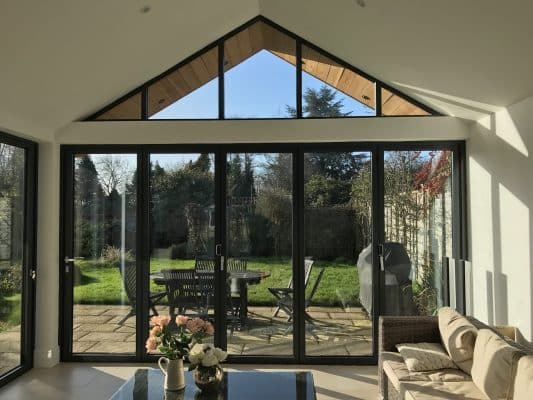
A contemporary extension is one of the clearest examples. Many modern extensions are designed to maximise natural light and create uninterrupted views across landscaped gardens. In these projects, sliding doors often reinforce the architectural concept by minimising visible framing and allowing expansive areas of glass to become a defining feature of the living space. Even when closed—which is how they spend most of the year—they maintain a strong visual connection with the outdoors, making the garden feel like an extension of the interior.
Kitchen extensions often present a different set of priorities. These spaces have become the social centre of many homes, accommodating cooking, dining, entertaining and everyday family life within one open-plan environment. Where the ambition is to remove the physical boundary between the house and a patio or terrace during warmer months, bifold doors can provide the flexibility to transform the entire opening into a seamless transition between inside and outside. The architecture becomes less about framing views and more about encouraging movement and interaction.
Self-build projects frequently offer the greatest opportunity for careful specification because the building can be designed around the chosen glazing system from the outset. Some contemporary self-builds use sliding doors to reinforce clean architectural lines and maximise panoramic views across the surrounding landscape. Others prioritise flexible entertaining spaces where bifold doors allow the principal living areas to open almost completely onto gardens or courtyards. In both cases, the glazing system succeeds because it reflects the original architectural vision rather than being introduced as an afterthought.
Rural homes introduce additional considerations. Properties overlooking fields, woodland or open countryside often benefit from preserving uninterrupted views throughout every season, making sliding systems an attractive solution where the landscape itself forms part of the architecture. Conversely, homes centred around enclosed gardens or sheltered courtyards may place greater emphasis on creating generous physical openings that encourage outdoor living whenever the weather allows. The surrounding environment therefore influences the decision as much as the building itself.
Coastal properties present their own architectural priorities. Panoramic sea views naturally encourage large expanses of glazing, while exposure to wind and changing weather conditions demands careful specification regardless of opening style. Architects assess orientation, environmental exposure and the intended relationship with the landscape before determining whether uninterrupted views or maximum opening capability better supports the project. The location shapes the architecture, and the architecture in turn shapes the glazing specification.
Even two neighbouring houses can require entirely different solutions. Differences in garden design, internal layouts, family routines, furniture arrangements and long-term aspirations all influence which system feels most appropriate. This individuality explains why architects are cautious about making blanket recommendations based solely on product categories. Every project introduces its own priorities, and successful specification responds to those unique circumstances rather than relying on general assumptions.
Ultimately, the most successful homes are not remembered because they feature bifold or sliding doors. They are remembered because every design decision supports the way the building is intended to be lived in. When the glazing responds to the architecture, the landscape and the daily routines of its occupants, the question of which system is better quietly disappears. What remains is a home that feels comfortable, coherent and entirely natural to live in.
Section 8: Better Architecture Comes Before Better Products
Comparisons between bifold and sliding doors often end with the expectation that one system should emerge as the clear winner. It is an understandable way to approach the decision, particularly when investing in a significant element of a renovation or self-build. Yet architects rarely reach their conclusions in this way. Rather than asking which product is best, they ask which solution best supports the architecture and the people who will live within it. The distinction may seem subtle, but it fundamentally changes the specification process.
The architecture should always lead the decision. Every home has its own priorities, whether that is framing distant views, creating seamless connections with a garden, maximising natural light or encouraging flexible family living. Once these objectives have been clearly defined, the choice between bifold and sliding doors often becomes much more straightforward. The glazing is no longer expected to solve every design challenge; it simply fulfils the role the architecture requires of it.
This approach also encourages homeowners to think beyond the excitement of the building project itself. New glazing is often viewed through the lens of completion day, imagining summer evenings with the doors fully open or admiring the transformation of a newly finished extension. While these moments are undoubtedly rewarding, they represent only a small proportion of the building’s lifetime. Architects therefore focus on how the doors will perform during ordinary mornings, quiet winter afternoons and countless everyday routines that ultimately define the experience of living in the home.
Long-term enjoyment depends on many interconnected decisions rather than one dramatic product choice. Natural light entering the room throughout the seasons, comfortable circulation between spaces, reliable operation after years of use and the continued relationship between the interior and the landscape all contribute to the success of the design. Whether these qualities are achieved through bifold or sliding doors matters less than whether they consistently enhance daily life.
It is also worth remembering that architectural trends inevitably evolve. Products that dominate magazine covers today may be replaced by different fashions in years to come. Buildings designed around enduring principles of proportion, comfort, functionality and thoughtful specification, however, tend to remain successful regardless of changing tastes. Choosing a glazing system because it supports these timeless architectural qualities is usually a more reliable strategy than following the latest design preference.
This broader perspective explains why experienced architects seldom begin conversations by recommending a particular opening style. They first seek to understand the building, its setting, the aspirations of the homeowner and the way the spaces will be occupied over time. Only once those questions have been answered does the specification begin to take shape. The product becomes the conclusion of the design process rather than its starting point.
For homeowners, this provides a more confident way of approaching the decision. Instead of asking whether bifold or sliding doors are better, it becomes far more valuable to ask which system helps the architecture achieve its full potential. That single change in perspective shifts the focus from comparing products to creating a home that performs beautifully throughout every season and every stage of ownership.
Ultimately, the finest homes are not defined by the type of doors they contain. They are defined by the way every architectural decision works together to create spaces that feel comfortable, intuitive and connected to the lives of the people who inhabit them. Whether that relationship is achieved through bifold or sliding doors is far less important than ensuring the choice has been guided by architecture rather than by comparison alone.